How We Farm
Regenerative isn't just a word to us. It's how we make decisions.
You've probably heard the word regenerative thrown around a lot lately. We have, too. And while we're glad more people are talking about healthier soil, better animal care, and where their food comes from, we think those words ought to mean something.
So what does regenerative farming actually look like on our farm?
It looks like moving our animals through fresh pasture and giving the land time to recover. It means using the natural impact of our livestock to help build healthier soil rather than relying on synthetic fertilizers, herbicides, or pesticides. And it means paying attention—to the grasses growing beneath our feet, the condition of our animals, and the changes we see from one season to the next.
It also means making choices that aren't always the easiest or most profitable. Our dairy calves stay with their mamas. Our animals have room to express their natural behaviors. And we put a tremendous amount of thought into what they eat, how they're handled, and the lives they lead.
We're a veteran-owned, family-operated farm, and this isn't just a set of practices we put on a website. It's the work we get up and do every day.
We're not perfect, and we'll never pretend to have everything figured out. Farming has a way of teaching you something new every season. But we're intentional about our decisions, willing to explain why we make them, and always working to leave this land better than we found it.
We want healthy land, well-cared-for animals, and products we're proud to stand behind. And we believe the way we farm matters just as much as what we produce.
Below, we're sharing the details of how we farm—not just what we believe, but what we actually do.
1. Our Farming Philosophy & Land
-
For us, regenerative farming means working with the land instead of constantly trying to control it.
We don't look at our pastures as simply a place to keep livestock. We see the soil, grasses, animals, insects, birds, and surrounding wildlife as parts of a larger system. What happens to one affects the others.
That's why we practice adaptive multi-paddock (AMP) grazing. Rather than moving animals on a fixed schedule, we pay attention to how the pasture is growing, what the weather is doing, and what the land seems to need.
Our livestock help us manage that system. They graze, browse, root, and return nutrients to the soil through manure. We also use organic matter, including bedding and wood chips, to support the land rather than applying synthetic fertilizers, herbicides, or pesticides to our pastures.
And we're not going to pretend we have it all figured out.
Some things work beautifully. Other things teach us that we need to try a different approach.
To us, regenerative farming means paying attention, being willing to change course, and trying to leave this land healthier than we found it.
We're not farming for a perfect-looking pasture. We're farming for a healthier, more resilient ecosystem that can support our animals and the wildlife around us for years to come.
-
When we say our animals are pasture-raised, we mean they're actually out on pasture, doing what comes naturally to them.
Our cows graze, our pigs root, our chickens scratch and forage, and our goats browse. Those aren't just nice things to picture when you think about a farm. They're behaviors we believe matter to the animals' well-being.
But pasture-raised means more to us than simply giving animals access to grass.
It's about whether the pasture is being managed responsibly, whether the animals have enough to eat, and whether their environment is meeting their needs.
We rotate our grazing livestock based on pasture conditions, giving previously grazed areas time to recover. We also recognize that different animals have different nutritional needs.
Our cattle and goats rely heavily on forage, while our pigs and poultry need additional nutrition. We provide supplemental feed and minerals where appropriate.
We don't believe pasture-raised should mean an animal has to get by on grass alone.
And not every animal on our farm is managed the same way. Our quail, for example, live in a permanent, protected coop because that's the environment we've found works best for them.
For us, it's not about checking a box or putting a pretty picture on a label.
It's about making sure the way we raise our animals reflects the care we say we give them.
-
Because we're working to create a thriving, interconnected ecosystem—not just a farm with different animals on it.
Each species plays a role. Our cattle and goats graze and browse vegetation, returning nutrients to the soil through manure. Our pigs root and disturb the ground, helping us prepare areas for new pasture growth. Our chickens and ducks forage for insects and contribute to the natural nutrient cycle. Our quail have their own protected environment suited to their needs.
But our ecosystem extends far beyond the livestock we intentionally raise.
Over time, we've watched different species of wild birds make our farm their home, including cowbirds that associate with grazing livestock and feed on insects disturbed by their movement. We also share our land with foxes and other wildlife, all part of the broader food web.
We don't view a healthy farm as one where we control or eliminate everything that wasn't intentionally introduced. We want to encourage biodiversity while responsibly protecting our livestock and maintaining balance.
Our goal is to manage our land in a way that supports healthy animals, productive pastures, beneficial insects, birds, and native wildlife.
Because regenerative farming isn't just about what we raise. It's about the entire ecosystem we're helping to nurture.
-
We don't move our livestock according to a calendar. We move them according to what the pasture is telling us.
We practice adaptive multi-paddock (AMP) grazing, which means we're constantly looking at forage availability, plant growth, weather, ground conditions, and how an area responded to its previous grazing.
Sometimes a pasture simply needs more time to rest and regrow.
But sometimes recovery isn't about waiting longer. It's about figuring out what's missing.
Is the soil lacking something nutritionally? Would adding organic matter help? Could a different species of livestock benefit that area during its next rotation?
Those are the kinds of questions we ask.
Our animals interact with the land in different ways, so changing which species uses an area can be part of how we manage it.
We try to address problems through grazing decisions, natural nutrient cycling, and organic soil-building practices rather than reaching for synthetic fertilizers or chemical treatments.
And sometimes we have to admit that what we expected to work didn't.
Our goal isn't to move animals from one patch of grass to another. It's to understand what each pasture needs and help it become healthier over time.
-
We believe the condition of our animals can tell us a lot about the condition of the land they're living on.
We don't routinely send soil samples to a laboratory or track a long list of soil measurements.
Instead, we spend time watching our pastures and our livestock.
Are the grasses growing well? Are we seeing more plant diversity? Is the pasture recovering after grazing? Are our animals maintaining good condition and looking healthy?
Those observations help us understand what's working and where we may need to make changes.
We build soil health through managed grazing, manure, decomposing plant material, and organic matter such as bedding and wood chips.
And when an area isn't responding the way we'd like, we try to understand why rather than assuming it simply needs more time.
We're also planning to begin using SoilYield, an organic carbon-based fertilizer, in 2027 as another tool to support our pasture management.
We know that an animal's condition depends on more than pasture alone, including its feed, health, and stage of life. So we consider those things together rather than treating any one observation as the whole story.
We aren't trying to win an award for the greenest-looking grass. We want land that supports healthy animals and a thriving ecosystem.
And if something isn't working, we're willing to learn from it and change what we're doing.
-
No. We aren't certified organic, and we don't plan to pursue organic certification.
We've also explored other agricultural certifications and reached the same conclusion: they aren't the right fit for how we want to farm.
That isn't because we don't care about standards. Quite the opposite.
We care deeply about what goes into our animals, how they're raised, the condition of our soil, and the long-term health of our farm.
Our concern is that certification requirements can sometimes become the focus instead of a more important question:
Is this actually the best decision for this animal, this pasture, and this farm?
We don't believe the answer can always be found in a certification handbook.
Why don't you pursue certification?
Because farming isn't one-size-fits-all, and we want the flexibility to respond to what our animals and land actually need.
A dairy cow has different needs than a pig. An animal's requirements change with age, health, pregnancy, and lactation. And what works for one pasture may not work for another.
Sometimes that means trying a holistic approach. Sometimes it means calling the veterinarian and using conventional medicine. Sometimes it means changing our grazing strategy because the land isn't responding as expected.
We recognize that certified organic farmers also have a responsibility to treat sick animals. Our concern isn't that certification prevents responsible care, but that program requirements can affect which inputs and treatments are permitted and how animals or their products may subsequently be marketed.
We want our decisions guided first by the needs of our animals and land, not by whether those decisions fit a certification category.
Doesn't certification give customers peace of mind?
We understand why it does.
Certifications provide useful information, and there are excellent farmers who choose to participate in them.
But a certification tells you that a farm meets the requirements of a particular program. It doesn't necessarily tell you everything about how that farmer observes, adapts, or approaches individual decisions.
We believe customers deserve to understand more than what a label communicates.
We'd rather you know what we actually do than rely on a label without understanding the practices behind it.
So how can customers know what your standards are?
Ask us—and explore this How We Farm page.
We've worked hard to explain how we feed our animals, manage our pastures, care for sick livestock, practice calf-sharing, and make decisions about our land.
We don't use synthetic fertilizers, herbicides, or pesticides on our pastures, and we prioritize thoughtful animal care, appropriate nutrition, and regenerative land management.
But we're not claiming to meet USDA organic certification requirements, and we don't market our products as certified organic.
We also don't claim to have everything figured out. We're continually learning, observing, and adjusting our practices when we believe there's a better approach.
We don't want to farm for a label. We want to farm for the health of our animals, the health of our land, and the integrity of what we produce.
If that means we don't fit into a particular certification program, we're comfortable with that.
How we manage our land and why we make the decisions we do.
2. Animal Care & Welfare
What caring for animals actually looks like, including difficult decisions.
-
We love our animals, but we also believe there's a whole lot more to good animal husbandry than simply loving them.
It takes knowledge, patience, consistency, and a willingness to pay attention to the little things.
Every animal on our farm has different needs. What works for a dairy cow isn't necessarily what's best for a pig, chicken, or goat. It's our responsibility to understand those differences and provide each animal with the nutrition, environment, and care it needs to thrive.
We believe good husbandry starts with prevention, not simply reacting when something goes wrong.
That means paying attention every day. We're watching how our animals move, eat, and interact with one another. Sometimes the smallest change in behavior tells us something isn't quite right.
We focus on proper nutrition, clean living conditions, appropriate shelter, low-stress handling, and thoughtful pasture management.
But we're also realistic. Animals get sick. Injuries happen. And sometimes, despite our best efforts, things don't go according to plan.
When an animal needs help, its well-being comes first. We won't withhold necessary treatment to protect a label or uphold a particular farming philosophy.
We're constantly learning, too. The more time we spend with our animals, the more we realize there's always something new to understand about their health, nutrition, and behavior.
And while customers may only see the finished products at our market booth, there's a whole lot happening behind the scenes.
Early mornings, late nights, checking animals in bad weather, adjusting feed, moving fences, and noticing when something just doesn't seem right.
That's what caring for our animals looks like to us. It's not a marketing statement. It's a responsibility we take seriously every single day.
-
We never use growth hormones on our farm, and we don't routinely administer antibiotics or synthetic dewormers.
We prefer to focus on prevention through good nutrition, pasture management, careful observation, and a holistic approach to animal health.
When an issue arises, we often begin with appropriate holistic remedies and supportive care when the situation allows. But we're also realistic about the limits of those approaches.
Our animals' welfare will always come before our farming ideals.
If an animal needs antibiotics, synthetic dewormers, or another pharmaceutical treatment, we won't hesitate to use it when medically appropriate, working with our veterinarian as needed.
We will never allow an animal to suffer or risk losing its life simply because a necessary treatment doesn't fit a particular farming philosophy.
How do you manage parasites without routine deworming?
We use pasture rotations, thoughtful grazing management, and close observation to help manage parasite pressure.
Rather than automatically treating every animal on a fixed schedule, we pay attention to body condition, behavior, and signs that an individual animal may need additional care.
We recognize that pasture management alone can't eliminate parasites. When treatment is necessary, we'll use an appropriate dewormer.
What happens when medications are necessary?
When we administer medications, we follow veterinary guidance and applicable withdrawal periods before products from treated animals are used or sold.
We believe there's room for both holistic approaches and modern veterinary medicine. The responsibility lies in understanding when each is appropriate.
Our goal has never been to avoid medication at all costs. It's to raise healthy animals and care for them responsibly.
Our animals aren't here to uphold our ideals. They're here in our care, and that means their health, comfort, and quality of life come first. Always.
-
Yes, they do! And this is something we're especially passionate about.
We practice calf-sharing, which means our dairy calves stay with their mothers rather than being separated shortly after birth.
We believe cows should have the opportunity to mother their calves, and calves should have the opportunity to nurse, bond with their mamas, and learn from them.
In many conventional dairy operations, calves are separated from their mothers shortly after birth. We've chosen a different approach.
Our calves come first. We share the milk that's available after their needs are met.
That means milk availability changes depending on how much a calf is nursing, where its mama is in her lactation, and what she needs to stay healthy.
And we're okay with that.
Calf-sharing takes flexibility. We have to pay attention to each cow and calf, adjust our routines, and accept that some days there may be less milk available for our customers.
But there's something pretty special about watching a mama cow care for her baby and seeing calves grow and thrive alongside their mothers.
We're not going to pretend it's always the easiest way to operate a dairy.
But raising animals well has never been about getting the most out of them. It's about giving them the care and life they deserve.
And that's a commitment we're proud to stand behind.
-
Breeding and raising young animals are some of the biggest responsibilities we take on. These decisions affect the health of our mothers, the development of their babies, and how we manage our herds for years to come.
We try to work with our animals' natural reproductive patterns while recognizing that every animal has different needs.
How do you breed your cattle?
We keep our own bull and allow our cows to breed naturally. It's the approach that works best for our farm.
We also manage our cattle in separate groups based on their age, development, and reproductive needs rather than keeping everyone together.
When a cow is pregnant, we pay close attention to her body condition, nutrition, behavior, and overall health. We prefer to let pregnancy and birth progress naturally when everything is going well, but we'll step in or call our veterinarian when help is needed.
What happens after a calf is born?
Our dairy calves stay with their mamas and nurse as part of our calf-sharing approach. We've explained that practice in more detail in the previous question.
Once calves are weaned, we move them into a separate paddock with other weaned calves and yearlings.
We do this for their safety. Young cattle aren't always ready to be turned out with mature animals simply because they're no longer nursing.
As they grow, we evaluate when they're ready to join the appropriate breeding, dairy, or beef herd. We consider their size, development, and individual readiness rather than moving everyone at a predetermined age.
What about your Nubian dairy goats?
Our Nubians follow a different reproductive rhythm.
They typically come into heat in the fall as daylight hours shorten, so we work with their natural breeding season rather than trying to maintain year-round milk production.
We also don't intentionally extend their lactations just to produce more milk.
Female offspring may eventually join our dairy program, while male offspring are raised for meat. We're open about that because we believe responsible farming includes being honest about the purpose of the animals we raise.
Regardless of their future role, they all deserve proper nutrition, shelter, and care.
Why do you manage things this way?
Because we don't believe breeding should be reduced to a production schedule.
Keeping our own bull, allowing calves to stay with their mamas, giving younger cattle their own space, and respecting our goats' seasonal breeding patterns are all choices we've made based on what works for our animals and our farm.
We're not claiming our approach is the only right way to raise livestock.
We just believe that bringing an animal into the world comes with a responsibility to care for it thoughtfully at every stage of its life.
-
We put a tremendous amount of thought into how we raise our animals, but even with the best care, animals can get sick or injured. That's part of working with living creatures, and we don't believe any farm should pretend otherwise.
Our responsibility isn't to promise that nothing will ever go wrong. It's to recognize when something does and respond in the animal's best interest.
How do you know when something is wrong?
One of the advantages of being a small family farm is that we spend a lot of time with our animals. We get to know their personalities, routines, and little quirks.
Sometimes the first sign of trouble isn't obvious. An animal may be quieter than usual, less interested in feed, moving differently, or simply not acting like itself.
Knowing what's normal for our animals helps us recognize when something isn't.
What do you do when an animal needs help?
We assess what's happening and determine what kind of care is appropriate. Sometimes that means additional nutritional support, changes to the animal's environment, or closer observation. Other times, it means medication or veterinary treatment.
We appreciate holistic approaches when they're appropriate, but we also recognize their limitations. If a condition is serious, worsening, or beyond what we can safely manage, we involve our veterinarian.
We're not going to let an animal suffer just because a necessary treatment doesn't fit our preferred approach.
Where do sick or injured animals recover?
When an animal needs extra attention, we generally set up a separate recovery or isolation paddock or stall, depending on the species and situation.
This allows us to monitor eating, drinking, movement, and recovery more closely while providing a comfortable environment suited to that animal's needs.
If there's a concern about contagious illness, separation can also help protect the rest of the herd or flock.
What if an animal can't recover?
This is one of the hardest parts of raising livestock.
Sometimes, despite our best efforts, an animal's condition is too severe or treatment isn't successful.
When recovery is no longer a realistic possibility, we have to consider the animal's comfort and quality of life. If humane euthanasia becomes necessary, we approach that decision thoughtfully and with the animal's welfare first.
Those moments are never easy, and we don't take them lightly.
Loving animals means accepting responsibility for the difficult decisions, too.
We believe caring for livestock is about more than celebrating the healthy births and happy moments. It's about showing up when an animal needs us, even when the outcome isn't what we'd hoped for.
-
We believe that if we're going to raise animals for meat, we owe it to those animals—and to the people who support our farm—to be honest about what that means.
We raise beef cattle, pigs, and male offspring from our goat herd for meat.
An animal deserves a good life, regardless of whether it's being raised for milk, breeding, eggs, or meat.
Why do you raise animals for meat?
Different animals have different roles on our farm.
Our cattle help manage pasture vegetation, while our pigs play an important part in developing new pasture. We regularly rotate pigs into new paddocks, allowing them to root and disturb the ground before we seed behind them.
Our Nubian goats are part of our dairy program, but breeding dairy animals also means making responsible decisions about their offspring. Female kids may join our dairy herd, while males are raised for meat.
We don't believe those realities should be hidden from customers.
Do you get attached to animals you're raising for meat?
Of course we do.
When you spend time caring for animals, you get to know their personalities, habits, and little quirks.
Some are curious, some are cautious, and some make sure you know they're there every time you walk into a paddock.
We don't believe caring about an animal and raising it for meat are mutually exclusive.
If anything, that connection makes us more thoughtful about the responsibility we've taken on.
We understand that not everyone is comfortable with raising animals for meat, and we respect that. But for us, the answer isn't to become emotionally detached. It's to take their lives seriously.
How do you handle processing?
We work with local, small, family-owned USDA-inspected meat processors.
We transport our livestock ourselves using our trailer, and we take loading and transportation seriously.
We try to handle our animals calmly, give them time, and minimize unnecessary stress. We can't promise transportation is completely stress-free, but we can be responsible for how we handle them.
The care we give our animals throughout their lives should extend to how we treat them on their final day.
Do you use the whole animal?
We work closely with our processors to use as much of each animal as reasonably possible.
Raising livestock requires time, land, feed, water, labor, and a great deal of care. We don't believe those resources—or the animal's life—should be taken lightly.
Not every part can necessarily be recovered or used, but we make an effort to reduce unnecessary waste.
For us, that's another way of showing respect for the animal we've raised.
Why are you so open about this?
Because we believe people deserve to understand where their food comes from, including the parts of farming that aren't always easy to talk about.
We can care deeply for an animal, give it a good life, and still acknowledge that it's being raised to provide meat.
Those ideas aren't contradictory to us. They're part of the responsibility we accept when we choose to raise livestock.
And we believe being willing to talk about the difficult parts of farming is just as important as sharing the beautiful ones.
3. Our Animals & their Diets
-
What do you feed your dairy cows?
This is one of our favorite questions because what goes into caring for a dairy cow matters just as much as what comes out of the milk jar.
Our dairy cows spend their days on pasture, grazing a variety of grasses and forage as we rotate them through our paddocks.
Grass and forage are the foundation of their diet, year-round. During the growing season, that's fresh pasture. When winter slows everything down, we provide quality hay and additional forage to keep their nutrition where it needs to be.
We also supplement their diet with carefully chosen ingredients. Not because we're trying to squeeze every possible gallon of milk out of them, but because producing milk, nursing calves, and maintaining healthy body condition take a lot out of a cow.
What goes into their supplemental feed?
We're happy to tell you exactly what we feed our girls and why.
Chaffhaye or AlfaHay: Fermented alfalfa forage that provides fiber and protein to support their rumen and nutritional needs.
Alfalfa mash: Another source of forage-based protein, fiber, and calcium.
Beet pulp and molasses: Digestible fiber and additional energy, with molasses helping make their feed more appealing.
Flaxseed: A source of omega-3 fatty acids, energy, and protein.
Hemp hulls: A source of plant-based fiber and beneficial fats, including omega-3 and omega-6 fatty acids. Hemp hulls can contribute to a varied fatty acid profile in the diet while providing additional fiber. We appreciate being able to incorporate thoughtfully selected ingredients that support our cows' overall nutritional needs.
Black oil sunflower seeds: A natural source of healthy fats, energy, and vitamin E. Vitamin E is an important antioxidant that helps protect milk fats from oxidation, which can contribute to unwanted flavors. We include sunflower seeds as part of our approach to supporting healthy cows and maintaining the fresh, clean milk flavor we value—without that strong, undesirable "cowy" taste.
Free-choice kelp and Redmond minerals: Sources of minerals and salt that help round out their nutrition.
OGS (Organic Gut Solution): A carbon-based digestive supplement we use to support healthy gut function and help our cows make good use of the nutrients in their feed.
We don't use conventional commercial dairy pellets to push production. We'd rather put thought into the individual ingredients we're feeding and what each one contributes.
What do your cows eat in the winter?
We've put a tremendous amount of thought into this, because winter hay shouldn't be an afterthought.
We've built relationships with local farmers who understand what we're trying to accomplish with our dairy herd.
We source quality, unsprayed hay made up of a variety of pasture grasses, similar to what our cows graze during the warmer months.
We're also working with those farmers to customize hay for our dairy girls' winter nutritional needs.
That means we're not just buying whatever bales happen to be available. We're having real conversations about forage varieties, quality, and what our cows need when fresh pasture isn't growing.
Does every cow eat the same thing?
Not necessarily.
A cow nursing a calf and producing milk has different nutritional needs than a cow who's dry, pregnant, or at another stage of life. And the quality of our pasture changes with the seasons.
We pay attention to body condition, appetite, and overall health, and adjust supplemental feeding as needed.
Our cows aren't milk machines. They're living animals with individual needs, and their nutrition should reflect that.
We're proud to share what goes into their feed because we think you deserve to know how the animals behind your dairy products are cared for.
And around here, good milk starts with a healthy, well-fed cow.
-
We raise three types of egg-laying poultry: chickens, ducks, and quail.
And while they're all birds, we've learned that what works beautifully for one species might not work at all for another.
We've had to figure out what makes each of them happy, healthy, and comfortable. Sometimes that's meant changing our plans when the birds showed us something wasn't working.
How do you raise your chickens?
Our laying chickens live in mobile chicken tractors that we move between pasture paddocks.
The tractors give them a familiar place for shelter, while the chickens are free to roam within whichever paddock they're in.
They spend their days scratching, pecking, exploring, and finding all sorts of things in the grass. Moving their tractors gives them fresh areas to forage instead of keeping them on the same patch of ground.
What about your ducks?
Our ducks have a permanent duck house near our lake, and they generally roam through the surrounding pastures and water.
They have their own routines, and we love watching them waddle around the farm, explore the grass, and head out onto the lake.
Their setup is different from the chickens', but it works for the way our ducks live.
Why do your quail live in a permanent coop?
Because we tried something different, and it didn't work.
We originally attempted rotational grazing with our quail. We thought giving them a changing outdoor environment would be a good thing.
Unfortunately, our quail didn't do well with the constant changes. They're timid little birds, and the moving caused significant stress. We even experienced losses.
That was hard, and it made us rethink what we were doing.
We moved them into a permanent, protected coop, where they have familiar surroundings and places to feel secure.
And we've found they do much better that way.
We could have kept rotating them because it fit the picture people often have of regenerative farming. But that wouldn't have been fair to the birds.
We'd rather tell you why our quail live in a coop than keep doing something that wasn't working just so we could use a particular label.
What do your poultry eat?
We feed our birds a non-GMO laying mix from Tucker Milling, along with supplemental foods that include:
Alfalfa pellets for additional plant-based nutrition.
Oats during the winter as a seasonal addition.
Fresh herbs for variety.
Our chickens and ducks also forage as they explore their surroundings.
But we don't expect foraging alone to meet all their nutritional needs, and we recognize that chickens, ducks, and quail don't have identical dietary requirements.
We pay attention to how our birds are doing and adjust their care when needed.
What's the biggest lesson they've taught us?
That good intentions don't always mean you've found the right approach.
We can research something, put a lot of effort into it, and genuinely believe it's going to work. But if our animals aren't thriving, we have to be willing to admit that and make a change.
Our quail taught us that lesson in a pretty difficult way.
And it's one we've carried into how we care for every animal on our farm.
The animals themselves tell us a lot about whether we're getting things right. We just have to pay attention.
-
Our pigs are an important part of our farm, and not just because we raise them for meat.
They also help us develop and improve our pastures.
Pigs are curious, intelligent animals that love to explore, dig, and root around with their snouts. Rather than trying to stop them from doing what comes naturally, we've found ways to put those instincts to work.
Do your pigs live on pasture?
Yes! We regularly rotate our pigs through different pasture paddocks, giving them new areas to explore while helping us manage their impact on the land.
If you've ever watched pigs root around, you know they can make quite a mess of the ground in a hurry!
But that disturbance can also be useful when it's managed carefully.
As our pigs root, they turn over existing vegetation and expose patches of soil. We follow behind them with seed, using the areas they've disturbed as an opportunity to establish new forage.
Of course, too much rooting in one place can cause problems. We pay attention to how quickly they're working an area, move them when needed, and give the pasture time to recover.
Our pigs aren't just living on the pasture. They're helping us build the next generation of it.
What do your pigs eat?
The foundation of their diet is a non-GMO pig feed from Tucker Milling.
We also supplement with suitable foods from around the farm, including:
Garden scraps when we have them.
Leftover milk and whey from making mozzarella.
The whey is one of our favorite examples of how different parts of our farm work together.
Our cows give us milk, we use some of that milk to make mozzarella, and the leftover whey becomes a supplemental food source for our pigs.
It's a practical way to make better use of what we produce instead of letting something useful go to waste.
That doesn't mean our pigs are fed whatever happens to be left over. Their regular feed provides the foundation of their nutrition, and we're thoughtful about what else we give them.
Why do you rotate your pigs?
Because pigs can change a piece of ground pretty quickly, and we want that impact to be useful rather than destructive.
We don't move them according to a rigid calendar. We watch what they're doing, how the paddock is holding up, and what the weather is doing.
Sometimes they work an area faster than we expected. Sometimes the ground needs more recovery time before we bring animals back.
We adjust as we go.
That's one of the things we love about raising different kinds of livestock. Our cows graze, our goats browse, our chickens scratch, and our pigs root. Each animal has its own way of interacting with the land.
We're trying to build a farm where those different pieces work together, and our pigs are a pretty important part of making that happen.
-
If you've ever spent time around Nubian goats, you know they have personalities all their own.
They're curious, affectionate, vocal, sometimes mischievous, and usually convinced that whatever you're doing is something they need to investigate.
We raise Nubian dairy goats, and we love them for their personalities, those unmistakable floppy ears, and the rich milk they produce.
But raising goats has taught us that you have to work with their natural rhythms, not expect them to follow whatever production schedule would be most convenient for us.
Why Nubian goats?
Besides their big personalities, Nubians are known for milk that's often particularly rich in butterfat.
They're also generally seasonal breeders.
As the days get shorter in the fall, our does typically begin coming into heat. We work with that natural breeding season rather than trying to breed them continuously throughout the year.
Do you milk your goats year-round?
No, and that's intentional.
Our does generally breed in the fall and produce milk after kidding.
We don't intentionally extend their lactations just to keep milk flowing or guarantee that we'll have goat milk available every month of the year.
That means our goat milk is seasonal, and we're okay with that.
Our goats are more than their milk supply. We want them to have the time and care they need through breeding, pregnancy, kidding, lactation, and the periods when they aren't producing milk.
What happens to the baby goats?
Raising dairy goats means taking responsibility for the kids they bring into the world, too.
Our female kids may become part of our dairy herd, while male kids are raised for meat.
We're open about that because we don't think the realities of dairy farming should be hidden behind the milk jar.
Regardless of what an animal is being raised for, it deserves good care throughout its life.
What do your goats eat?
Goats are browsers, which means they like to pick through different plants and vegetation rather than simply graze grass like cattle.
And if you've ever raised goats, you know they're pretty opinionated about what they want to eat!
We keep quality forage at the foundation of their diet and provide supplemental nutrition and appropriate minerals based on their needs.
A growing goat, a pregnant doe, and a doe producing milk don't all have identical nutritional requirements. We pay attention to body condition, appetite, and the forage available as we make feeding decisions.
Their browsing habits also give them a different role in our pasture system than our cows or pigs.
What do you love most about raising Nubians?
Honestly, their personalities are a big part of it.
They're full of character, and they have a way of making even an ordinary day of farm chores entertaining.
But we also appreciate that raising them asks us to respect a different rhythm from our dairy cows.
We're grateful for the milk our goats give us, but we don't believe their value begins and ends with production.
If that means goat milk isn't available year-round, that's simply part of raising them the way we've chosen to.
Specific feeding and husbandry practices for every species.
4. Our Dairy & Milk Practices
-
We believe good milk starts long before a cow ever steps into the milking area.
It starts with how she's raised, what she's fed, how she's treated, and the decisions we make every day about her care.
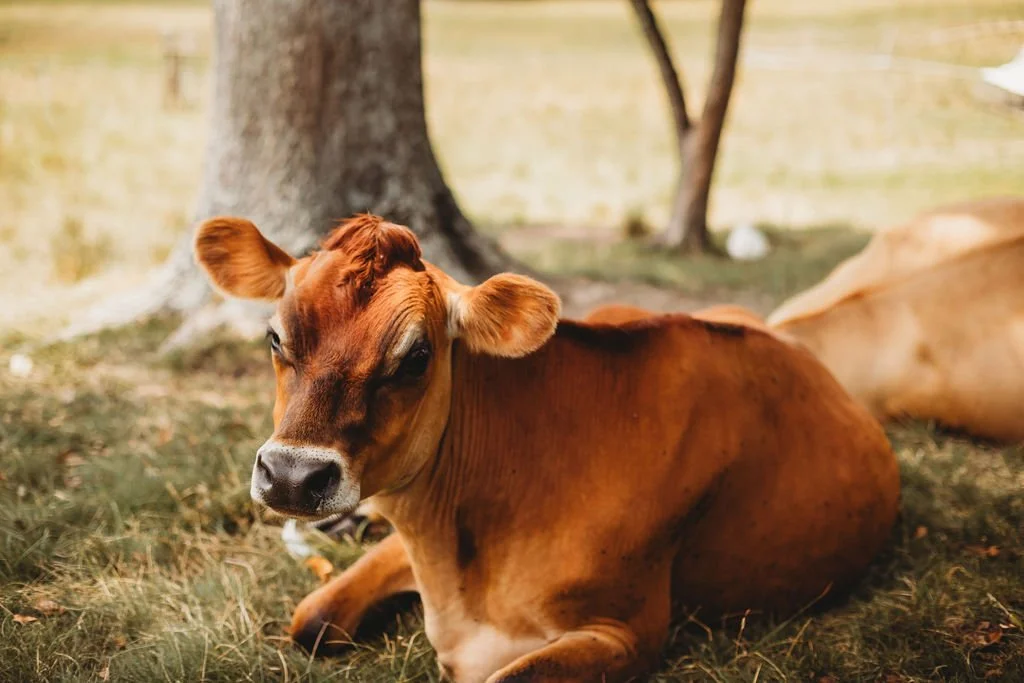
Our dairy is intentionally small. We raise A2A2 Jersey cows, practice calf-sharing, prioritize pasture and quality forage, and believe our cows' well-being matters more than how much milk we can produce.
There are easier ways to run a dairy. There are certainly ways to produce more milk. But we've chosen to do things in a way that makes sense for our girls and the kind of farm we're trying to build.
Why Jersey cows?
We love our Jersey girls!
Jerseys are known for their rich, creamy milk, with naturally occurring butterfat and protein. They're also a wonderful fit for the smaller, pasture-focused dairy we're building.
But beyond the milk, we love getting to know each cow as an individual.
They all have their own personalities, preferences, and little quirks. Some are more opinionated than others, and believe us, they aren't shy about letting us know!
Because our herd is small, we notice those things. We know their routines, recognize when someone isn't acting quite like herself, and can give each girl individual attention.
That's one of our favorite parts of keeping a small dairy.
What does A2A2 mean?
Our cows are A2A2, which refers to the type of beta-casein protein they produce in their milk.
Some cows produce A1 beta-casein, some produce A2, and some produce both. Our cows produce only A2 beta-casein.
Some people find A2-only milk easier to digest, although everyone's experience is different and the research is still developing.
It's important to understand that A2A2 milk still contains lactose and is not suitable for someone with a cow's milk protein allergy.
We'll explain the science, including the difference between lactose and milk proteins, in more detail in our dedicated A2A2 question below.
Do your calves stay with their mamas?
Absolutely. And this is one of the parts of our dairy we're most passionate about.
We practice calf-sharing, which means our calves stay with their mothers, nurse from them, and get to grow up alongside their mamas.
We don't separate newborn calves simply so we can collect every possible drop of milk.
Our calves come first. We share the milk that's available after their needs are met.
That means we don't always have the same amount of milk available for customers, and we're comfortable with that.
What do you feed your dairy cows?
Our approach is forage-first.
Our girls graze pasture during the growing season, and we source quality, unsprayed hay from local farmers when fresh forage becomes limited.
We also provide carefully selected supplemental nutrition to support their health, body condition, and changing needs throughout lactation.
We've put a tremendous amount of thought into their feeding program, right down to the individual ingredients. You can read all about those in our dairy cow feeding question above.
We're not trying to push our girls to produce the most milk possible. We want them healthy, comfortable, and well-fed.
Why keep your dairy small?
Because we want to be personally involved in every part of it.
We typically milk two cows at a time, which gives us the opportunity to pay attention to each girl and keep milking a calm, familiar routine.
We're also the ones collecting, handling, filtering, and cooling the milk.
When something needs attention, we're the ones responsible for addressing it.
We don't believe being small automatically makes a dairy better. But it does give us the opportunity to know our cows, stay close to the process, and take responsibility for the details.
And those details matter to us.
Does that mean you always have milk available?
Not always.
Milk production naturally changes throughout a cow's lactation, and our calves' needs come before the amount we have available to sell.
We do our best to plan ahead, but we aren't going to change how we care for our cows and calves just to guarantee a certain number of jars every week.
We know that can sometimes be inconvenient for customers, and we appreciate the patience and understanding that comes with supporting a small dairy like ours.
So what really makes your dairy different?
It's not just the breed of cow we raise, the ingredients we feed, or the fact that our calves stay with their mamas.
It's how all those decisions fit together.
We want our cows to live good lives. We want their calves to grow up alongside them. We want to be thoughtful about what our girls eat, careful about how we handle their milk, and honest with the families who trust us.
We're not interested in producing the most milk.
We're interested in raising healthy, well-cared-for cows and being proud of every jar that leaves our farm.
-
When you bring home a jar of milk from our farm, we want you to know how much care goes into collecting, handling, and testing it.
Our milking routine starts before the first drop of milk reaches the collection container, and it doesn't end when the milk goes into a jar.
We're personally involved in every part of that process, and we take that responsibility seriously.
How do you prepare your cows for milking?
Because our dairy is small, we get to work with our girls individually and keep a familiar, consistent milking routine.
Before we start, we pay attention to each cow, check the cleanliness of her udder and teats, and prepare her for milking.
We also keep an eye on the milking area itself. Clean surroundings, properly prepared cows, and equipment that's ready to use all matter.
We want milking to be a calm, predictable part of our girls' day, not something they're rushed through.
How do you clean your milking equipment?
Milk comes into contact with several surfaces before it reaches a jar, so cleaning those surfaces is a big part of our routine.
We thoroughly clean our refrigerated bulk tank multiple times each week, along with maintaining regular cleaning procedures for our milk canisters, milking claws, and other equipment.
We use different products for different cleaning needs, including vinegar, hydrogen peroxide, ozone-based products, and enzyme cleaners.
We've also added EC3 Enzyme Cleaner Concentrate to help address organic buildup and mold-related cleaning concerns in our canisters and milking claws.
EC3 is a company our family has trusted for years. During Daniel's military service, we dealt with mold exposure in homes we lived in, and that experience made us especially attentive to cleaning products and routines.
That history is part of why we chose to try EC3, but we also understand that cleaning and sanitizing aren't the same thing. Products need to be used appropriately, and milk-contact equipment requires proper cleaning, rinsing when needed, and sanitation.
You can read more about the product here: EC3 Enzyme Cleaner Concentrate.
How do you cool and filter your milk?
We use a refrigerated bulk tank to cool our milk quickly after milking.
Fresh milk is warm, and bacteria can multiply more rapidly if it isn't cooled promptly. That's why we use equipment designed for milk cooling rather than depending on a household refrigerator to slowly bring down the temperature.
We also filter our milk twice to remove visible particles that may be introduced during collection and handling.
Filtering is useful, but it doesn't pasteurize milk or remove every potentially harmful microorganism. We think it's important to be clear about that distinction.
How do you clean your glass jars?
Every jar goes through a cleaning process before we fill it.
We wash our glass jars with hot water, run them through the dishwasher, and finish with an ozone rinse.
We love using glass because it's reusable, but that also means taking responsibility for thoroughly cleaning it between uses.
Do you test your milk?
Yes! We have an in-home milk-testing lab, and we test every batch using Charm Sciences testing plates.
We use Charm Aerobic Count Plates and Charm E. coli/Coliform Plates to help us monitor bacterial counts and look for signs that something in our cleaning, cooling, or handling routine needs attention.
We use the published benchmarks from the Raw Milk Institute (RAWMI) to guide our monitoring.
Here's what we're looking at:
Aerobic bacterial count: A general indicator of bacterial levels in milk. RAWMI's benchmark is a three-month rolling average below 5,000 CFU/mL.
Coliform count: An indicator that can help identify sanitation or contamination concerns. RAWMI's benchmark is a three-month rolling average below 10 CFU/mL.
E. coli testing: Another indicator we use to look for possible contamination concerns.
CFU/mL means colony-forming units per milliliter, a way of expressing the number of bacteria detected under the conditions of a test.
We want to be clear about two things.
First, we use RAWMI's published benchmarks, but we are not RAWMI certified or listed.
Second, these are indicator tests. They help us evaluate our practices, but they do not test for every harmful pathogen. A general E. coli test, for example, isn't the same as a test specifically identifying dangerous strains such as E. coli O157:H7.
We don't test because we think our routines are perfect. We test because we want information that helps us recognize problems and improve.
Does all of this mean raw milk is completely safe?
No. Raw milk carries risks because it hasn't been pasteurized.
Even healthy cows and carefully managed milking practices cannot eliminate every possibility of contamination.
Clean equipment, properly prepared cows, rapid cooling, filtration, and bacterial testing are all important parts of our routine. But none of them, alone or together, can guarantee that raw milk is free of harmful microorganisms.
Pasteurization is an additional food-safety step that reduces the risk of illness from milkborne pathogens.
We don't want anyone to confuse the care we put into handling milk with a promise that raw milk is risk-free.
Why are we so particular about all of this?
Because we know exactly how much work goes into every jar.
We're the ones caring for the cows, preparing for milking, cleaning equipment, cooling and filtering milk, washing jars, and running the tests.
And when something needs improvement, we're the ones who have to figure it out and make the change.
We want every jar to reflect the care we put into our cows, our farm, and the work we do each day.
We're always willing to answer questions about our process. We'd much rather explain what we actually do than ask you to take our word for it.
-
Our dairy cows are A2A2 Jerseys, and there's a very personal reason for that.
For our family, A2A2 isn't just something we decided would look good on a milk label.
Mandie is very sensitive to the A1 beta-casein protein found in some cow's milk. Because of her experiences with dairy, she went almost ten years without consuming it.
It wasn't until we found milk from cows with verified A2A2 genetics that dairy became part of her life again.
After nearly a decade without it, that was a pretty big deal!
That experience played a huge role in the kind of dairy herd we wanted to raise. But we also know that everyone's body is different, and what worked for Mandie won't necessarily work for someone else.
What's the difference between A1 and A2 milk?
Cow's milk contains several naturally occurring proteins, including one called beta-casein.
A1 and A2 are two different variants of that protein, and a cow's genetics determine which ones she produces.
A1A2 cows produce both A1 and A2 beta-casein.
A2A2 cows produce A2 beta-casein rather than A1.
Jerseys are often associated with A2 milk, but being a Jersey doesn't automatically mean a cow is A2A2.
That's why we don't rely on breed alone.
How do you know your cows are A2A2?
We genetically test our cattle through the University of California, Davis (UC Davis).
Using hair or blood samples, we can verify each animal's beta-casein genetics rather than guessing.
That information helps guide our breeding and herd-management decisions.
Given Mandie's experience, this matters a lot to us. We don't want to call our milk A2A2 simply because we think our cows probably carry those genetics.
We want to know.
Is A2A2 milk easier to digest?
For some people, it may be.
Some studies have found differences in digestive symptoms when people consume A2-only milk instead of milk containing A1 beta-casein. But the research is still developing, and that doesn't mean everyone will experience the same results.
Mandie's experience is part of our family's story, not a promise about how someone else's body will respond.
We can verify our cows' A2A2 genetics. We can't guarantee that their milk will agree with everyone.
Is A2A2 milk lactose-free?
No. A2A2 milk still contains lactose.
Lactose is the naturally occurring sugar in milk. A1 and A2 refer to milk proteins, not milk sugar.
Someone who has difficulty digesting lactose may still have symptoms after drinking A2A2 milk.
And being raw doesn't make milk lactose-free, either.
What about someone with a milk allergy?
A2A2 milk is not safe for someone with a cow's milk protein allergy.
It still contains cow's milk proteins that can trigger an allergic reaction.
A milk allergy can be serious, and we would never encourage someone to try our milk based on the assumption that A2A2 makes it allergy-safe.
Is A2A2 the same as raw milk?
No. They're two completely different things.
A2A2 describes the type of beta-casein protein a cow produces.
Raw means the milk hasn't been pasteurized.
Milk from A2A2 cows can be raw or pasteurized. And A2A2 genetics don't eliminate the food-safety risks associated with raw milk.
Why does all of this matter so much to us?
Because we remember what it was like when dairy wasn't something Mandie felt she could enjoy.
Finding A2A2 milk made a meaningful difference in her life, and that experience helped shape the dairy we're building today.
It's why we invest in genetic testing, pay attention to A2A2 status when making herd decisions, and want customers to understand exactly what the designation means.
We're passionate about A2A2 milk, but we don't need to exaggerate its benefits to explain why it matters to our family.
Our family's experience explains why we care. Genetic testing helps us verify what we're raising. And transparency is how we share that information with you.
-
One of the things that makes our dairy a little different is that we share our cows' milk with their calves.
Our calves stay with their mamas and nurse, so we don't approach milking with the expectation that every drop belongs to us.
That means the amount of milk we have available for customers can change from week to week.
Why isn't the same amount of milk available every week?
Because we're working with living animals, not a fixed production schedule.
Every cow produces a different amount of milk, and her production changes throughout her lactation. Meanwhile, her calf is growing, and how much that calf nurses changes, too.
Some weeks, there's plenty of milk to share. Other weeks, there's less.
We work with what our cows produce after making sure their calves' needs are met.
Do the calves really get priority?
Yes. Absolutely.
Our calves aren't an inconvenience to our dairy. They're part of it.
We want them to have the milk they need, and we plan our bottling and other dairy production around what's available afterward.
That sometimes means making less than we'd like, but it's a choice we're comfortable with.
Does this affect your other dairy products?
It sure does!
Milk is the starting point for so many things we make, including yogurt, cream, butter, ice cream, and mozzarella.
Some weeks we have enough milk to bottle and make several other products. Other weeks, we have to choose which products we can reasonably make.
So if your favorite flavor of yogurt or a particular dairy product disappears from the farmstore for a little while, it doesn't necessarily mean we've stopped making it.
Sometimes we simply don't have enough milk for another batch.
What does this mean when I want to order?
The best place to check is our online farmstore, where you can see what's currently available.
We do our best to plan ahead, but we can't guarantee that every dairy product will be in stock every week.
We know that's different from walking into a grocery store and expecting the same items to be on the shelf every time.
And we genuinely appreciate the customers who understand that supporting a small family dairy sometimes takes a little flexibility.
Is calf-sharing worth those limitations?
For our family, absolutely.
We know it can mean fewer jars to sell, smaller batches of dairy products, and occasionally having to tell someone we're sold out.
But we'd rather be upfront about those limitations than change how we raise our calves just to keep more products on the shelf.
Our calves get to stay with their mamas. We build our milk production around that, not the other way around.
And we're grateful for every customer who chooses to support us knowing that's how we do things.
-
There are a lot of strong opinions about raw milk and pasteurized milk, and we understand why. People want to know where their milk comes from, how it's handled, and what they're actually getting.
We think those are important conversations to have.
But we also believe there's a difference between sharing why we've chosen certain farming practices and making claims that aren't supported by evidence.
The biggest difference is simple: raw milk hasn't been pasteurized. Pasteurized milk has undergone a controlled heating process designed to kill harmful microorganisms.
What exactly is raw milk?
Raw milk is milk that hasn't undergone pasteurization.
It's collected from the animal, then handled through steps such as filtering, cooling, and refrigeration without being subjected to the heat treatment used in pasteurization.
But raw doesn't mean free of bacteria.
Even milk that looks, smells, and tastes perfectly normal can contain harmful microorganisms.
What does pasteurization do?
Pasteurization heats milk to a specific temperature for a specific amount of time to kill disease-causing microorganisms and significantly reduce the risk of foodborne illness.
It's an important food-safety measure.
Pasteurization doesn't mean a farmer doesn't care about cleanliness, and raw milk doesn't automatically mean a farmer is careless.
How milk is produced and handled matters. Whether it has undergone pasteurization matters, too.
They're two different parts of the conversation.
Does pasteurization change the milk?
Yes, heating can change certain proteins, enzymes, and other components of milk. Some people also notice differences in taste or texture.
But pasteurization doesn't strip milk of its nutritional value.
Both raw and pasteurized milk contain protein, fat, minerals, and lactose. Pasteurization generally has little effect on milk's overall nutritional value.
You'll sometimes hear people talk about the enzymes and naturally occurring bacteria in raw milk.
Those things can be present, but naturally occurring doesn't automatically mean beneficial or safe.
Some microorganisms are harmless. Others can make people seriously ill.
We don't think it's responsible to suggest that raw milk is healthier simply because it hasn't been heated.
Can raw milk contain harmful bacteria?
Yes. And we think it's important to be straightforward about that.
Raw milk can contain pathogens such as E. coli, Salmonella, Campylobacter, and Listeria.
These can cause serious foodborne illness, with especially high risks for young children, pregnant people, older adults, and people with weakened immune systems.
Healthy cows, clean equipment, and careful milk handling are important, but they cannot guarantee that raw milk is free from pathogens.
Pasteurization provides a layer of food-safety protection that cleaning, cooling, and routine testing cannot replace.
What about your milk-cleaning and testing practices?
We put a tremendous amount of care into preparing our cows, cleaning equipment, filtering milk, cooling it quickly, and keeping it refrigerated.
We also have an in-home testing setup and test every batch using Charm Sciences aerobic count and E. coli/coliform plates.
Those tests help us monitor bacterial counts and recognize when something in our routine may need attention.
But they're not a guarantee that harmful pathogens are absent.
We test because we want useful information about our milk-handling practices, not because testing makes raw milk risk-free.
You can read more about our cleaning and testing routines in the previous milk-safety question.
Does A2A2 milk change any of this?
No.
A2A2 refers to the type of beta-casein protein our cows produce. It doesn't tell you whether milk has been pasteurized or whether harmful microorganisms are present.
A2A2 milk isn't automatically safer, lactose-free, or suitable for someone with a cow's milk protein allergy.
Those are separate issues, and we don't want customers confusing them.
What is your farm currently licensed to sell?
Our raw milk is sold under our Georgia Commercial Feed License for animal use only. It is not licensed or approved for human consumption.
That distinction matters regardless of how carefully we care for our cows or handle and test their milk.
We have plans for a dedicated creamery in the future, but we haven't reached that stage yet. We won't represent our dairy products as approved for human consumption unless and until we have the appropriate licensing and approvals.
We want people to understand what we're offering and how it's regulated.
Why are we so open about this?
Because we don't think people should have to choose between hearing a farmer's personal experience and getting accurate information.
We're proud of our cows, the way we raise them, and the work we put into every milking.
We're also comfortable acknowledging that raw milk carries risks that pasteurization substantially reduces.
Being proud of our practices doesn't mean pretending they eliminate every risk.
We'd rather have an open conversation, answer questions, and be clear about what we do—and what we can't promise.
-
One thing we want customers to understand about dairy is that the work doesn't stop when the milk leaves the cow.
How we cool, bottle, store, and transport our milk matters just as much as the care we put into collecting it.
We work hard to keep our milk and other refrigerated dairy products cold throughout the process, whether they're still here on the farm, traveling to a farmers market, or heading out for home delivery.
What happens to the milk after milking?
After milking, our milk goes into a refrigerated bulk tank, where it's cooled quickly and kept cold until we're ready to bottle it.
We don't leave freshly collected milk sitting around waiting for a convenient time to deal with it.
Cooling it promptly is an important part of our routine, and having a dedicated bulk tank allows us to do that.
How do you store milk after bottling?
Once we've bottled the milk, it goes into a closed refrigerator without a glass display door, where it stays refrigerated until it's time to prepare an order or head to a market.
We chose that setup because we're more concerned with maintaining consistent refrigeration than displaying jars through a window.
It's a small detail, but one we've put thought into.
How does your milk stay cold at farmers markets?
Our market trailer has its own refrigeration, powered by generators.
We run that refrigeration while traveling to and from markets, as well as while we're set up and selling.
That means our refrigerated products aren't just sitting in coolers for the entire market day.
We've put a lot of work into our market setup because we want the attention we give our milk at home to continue when we're away from the farm.
What about home deliveries?
For home deliveries, we use insulated coolers packed with ice packs to help keep our milk chilled while we're on the road.
It's a different setup from our refrigerated market trailer, but the purpose is the same: keeping temperature-sensitive products cold while they're in our care.
Why is keeping milk cold so important?
Milk is perishable, and refrigeration helps slow bacterial growth.
But keeping milk cold doesn't make raw milk the same as pasteurized milk, and it doesn't guarantee that harmful microorganisms aren't present.
That's why refrigeration is only one part of our handling routine, alongside cleaning, careful milk collection, and testing.
We've explained those practices in more detail in our milk-cleanliness and safety question.
What should I do once I receive my order?
Please follow the storage instructions provided with your products and refrigerate or freeze temperature-sensitive items as directed.
Avoid leaving them sitting in a warm vehicle or out on the counter.
Our raw milk is sold under our Georgia Commercial Feed License for animal use only and is not licensed or approved for human consumption. That doesn't change the importance of proper cold storage.
Why do you put so much effort into all of this?
Because after everything that goes into raising our cows, caring for their calves, and collecting and handling the milk, we don't want to overlook what happens on the way to our customers.
From our bulk tank to our bottled-milk refrigerator, our market trailer, and our delivery coolers, every part of the process has a purpose.
We want the care we put into producing our milk to continue all the way through handing over the finished product.
And we think you deserve to know what that actually looks like.
-
One thing you'll notice about shopping with us is that we don't always have everything available.
Some weeks we have plenty of milk. Other weeks, we have very little. Certain products are seasonal, and sometimes something sells out before you get a chance to order.
We know that can be frustrating, especially when you've found a favorite!
But we're a small working farm, and what we have available depends on our animals, the seasons, and what we're able to make.
Why does milk availability change?
Our calves stay with their mamas and nurse, so the amount of milk we have available depends partly on how much they're drinking.
Our cows' milk production also changes throughout lactation. And because we have a small dairy herd, those changes can make a noticeable difference in what we have to bottle or turn into other products.
Our cows and calves come first. We work with the milk that's available after their needs are met.
What about goat milk?
Our Nubian goats generally breed in the fall, and we allow their milk production to follow their seasonal lactation cycles.
We don't intentionally keep them in milk year-round just to guarantee a steady supply.
That means goat milk is available during certain times of the year, and there will be stretches when we don't have any.
Why aren't your eggs and meat always available?
Our laying hens don't produce the same number of eggs every day of the year. Daylight hours, weather, age, and other seasonal factors can all affect production.
And raising animals for meat takes time.
Our cattle, pigs, and goats need time to grow and mature, and processing happens when the animals are ready and arrangements can be made with our processors.
We don't have an unlimited supply waiting in reserve.
Why not just raise more animals?
Because more animals mean more pasture, feed, fencing, shelter, chores, and time.
We have to think about what our land can support and whether we can continue giving every animal the attention it deserves.
We do want our farm to grow, but we want to do it thoughtfully.
We'd rather occasionally tell you we're sold out than grow so quickly that we compromise the way we care for our animals.
How can I find out what's available?
The best place to check is our online farmstore.
We update our offerings based on what we have available, so it's worth checking back if something you're looking for is out of stock.
And you're always welcome to ask us when a product might return. We may not have an exact date, but we'll gladly share what we know.
There's something special about buying from a farm where the products reflect the actual seasons and rhythms of the animals.
It may take a little more flexibility than shopping at a grocery store, but that's part of what makes supporting a small family farm different.
From caring for the herd to handling, testing and processing milk.
5. Our Products & Future Creamery
-
When we first started building our farm, we were focused on raising animals thoughtfully and learning how to make the most of what they provided.
Over time, that's turned into quite a variety of products!
Today, we're raising dairy cows, dairy goats, egg-laying poultry, and livestock for meat. And somewhere between all the chores, we've also been learning how to turn what our farm produces into a growing selection of small-batch products.
We don't just want to produce more. We want to make thoughtful use of what we already have.
What dairy products do you make?
Dairy is a big part of our farm, and we've had a lot of fun learning to make more than just milk.
Our growing lineup includes:
Milk
Yogurt in a variety of flavors
Cream
Butter
Ice cream
Mozzarella
Every product has its own process, equipment needs, and learning curve.
And because we share our cows' milk with their calves, what we can make depends on how much milk is available after the calves have what they need.
Sometimes that means plenty of milk for bottling and other products. Other times, we have to choose what we can make with what we have.
Do you offer eggs?
Yes! We raise chickens, ducks, and quail for eggs.
Our chickens live in mobile tractors and get to roam within their pasture paddocks. Our ducks have a house near the lake and spend their days exploring the surrounding pasture and water.
And our quail? Well, they taught us that not every animal appreciates our ideas about pasture rotation!
After trying different arrangements, we found they're much happier and safer in a permanent, protected coop.
Each species has its own needs, and egg production changes with the seasons, the birds' ages, and other factors. So the types and quantities of eggs we have available can vary.
What about meat products?
We raise beef cattle, pigs, and male goats for meat.
We work with local, small, family-owned USDA-inspected processors and transport our livestock ourselves.
Raising animals for meat is something we take seriously, and we want to make thoughtful use of as much of each animal as reasonably possible.
That's also part of why we've been developing bone broths.
Meat isn't something we can restock overnight, though. Our animals need time to grow, and processing has to be scheduled. When a particular cut or product sells out, it may be a while before we have more.
Do you make everything in large batches?
Not even close!
We're a family-operated farm, and our production has to fit around animal care, equipment, available ingredients, and the number of hours in a day.
Some products are made in small batches. Certain flavors may only be available for a short time, and sometimes we have an idea we're excited about but need a little more time to get it right.
We'd rather make what we can manage well than promise a constant supply we can't realistically maintain.
Are your products available year-round?
Not all of them.
Our cows' milk production changes throughout lactation, our goats have seasonal breeding and milking cycles, egg production fluctuates, and meat availability depends on when animals are ready for processing.
We've explained those seasonal realities in more detail elsewhere on this page.
The easiest way to see what we currently have is to visit our online farmstore.
What about licensing?
Our raw milk is sold for animal use only under our Georgia Commercial Feed License. It is not licensed or approved for human consumption.
Other products may fall under different regulatory requirements, so we don't want to suggest that every item we produce is covered by the same license.
We're working toward a properly established creamery in the future, but that's a goal we're still building toward, not something we've already accomplished.
Why do you make so many different things?
Because we genuinely enjoy learning, creating, and finding ways to make better use of what our farm provides.
When we make mozzarella, for example, we end up with whey. Instead of simply throwing it away, we can use it as supplemental feed for our pigs.
When we work with our meat processors, we look for opportunities to use more of each animal rather than focusing only on the familiar cuts.
And every new dairy product gives us another way to work with the milk our cows produce.
We don't see these as a bunch of unrelated products.
We see a connected farm, where the animals, the land, and what we produce all play a part in one another's story.
And we're still finding new ways to make those connections as we grow.
-
We believe customers deserve to understand exactly how our farm operates, including what our current licensing does and does not allow.
We hold a Georgia Commercial Feed License. Products we offer under that license are intended for animal use only. They are not licensed or approved for human consumption.
We want to be completely upfront about that.
We also want people to understand that our licensing status is separate from the care we put into raising our animals, handling our milk, and making our products.
Both things matter, but they aren't the same thing.
What exactly is a Georgia Commercial Feed License?
In Georgia, commercial animal feed, including pet food, is regulated by the Georgia Department of Agriculture.
A Commercial Feed License is part of the regulatory framework for businesses that manufacture or distribute animal-feed products.
It is not a dairy-processing permit, a creamery license, or an approval to produce food for human consumption.
Different products may also have additional requirements involving registration, labeling, manufacturing, or distribution.
We don't want anyone to assume that having a Commercial Feed License means we've received approvals that we haven't.
Does that mean your products aren't approved for people to eat or drink?
Correct. Products sold under our Commercial Feed License are for animal use only, not human consumption.
We know some of the names of our products—milk, yogurt, butter, mozzarella, and others—are familiar because they're also names of foods people eat.
But a familiar product name doesn't change how that particular product is licensed, labeled, or intended to be used.
If a product is labeled for animal use, that's what it's being sold for.
We want customers to understand that distinction before purchasing, not discover it afterward.
And because different types of farm products can fall under different regulations, we don't want to imply that every item we offer is covered by the same license. The labeling and intended use of each product matter.
Why do you put so much effort into milk cleanliness and testing if it's for animal use?
Because we still care deeply about how our animals are raised and how our products are handled.
We're the ones preparing our cows for milking, cleaning the equipment, cooling and filtering the milk, washing jars, and monitoring our processes.
We also have an in-home testing setup and test every batch of milk using Charm Sciences aerobic count and E. coli/coliform plates.
We do that because we want useful information about our cleaning and milk-handling routines. If something needs attention, we want to know.
But testing doesn't make raw milk risk-free, replace pasteurization, or change what our license allows us to sell.
Those are important distinctions, and we don't want our customers confusing them.
We can take pride in doing careful work without claiming that our practices provide guarantees they cannot provide.
Why aren't you licensed to produce dairy foods for human consumption yet?
Because building a fully operational creamery involves a whole lot more than having dairy cows and knowing how to make cheese.
It takes suitable facilities, specialized equipment, established procedures, and the appropriate inspections, permits, and approvals.
And we're still a family running a working farm, caring for livestock, raising our girls, and building the infrastructure we need as we're able.
We're learning, investing in equipment, improving our processes, and figuring out how to take the next steps responsibly.
We have a vision for where we're going, but we don't want to pretend we're already there.
Are you planning to open a licensed creamery?
Yes! That's one of our long-term goals.
We want to build a dedicated creamery here on the farm where we can expand what we produce under the appropriate licensing and approvals.
It's something we're genuinely excited about.
But we also know there are important steps between having that dream and opening the doors of a properly licensed facility.
We don't have an approved creamery today, and we're not going to give customers a completion date we can't confidently promise.
We'll share our progress as we go.
Does your Commercial Feed License cover everything you sell?
Not necessarily.
Different products can be subject to different rules depending on what they are, how they're made, how they're labeled, and their intended use.
Our Georgia Commercial Feed License applies to the animal-feed products we offer under it. It doesn't automatically authorize every other product a farm might sell.
We want customers to look at the information provided for the specific product they're purchasing rather than assume that one license applies to everything on our farm.
And if you're ever unsure about a product's intended use, please ask us before purchasing.
Why are you so open about all of this?
Because transparency shouldn't stop at telling people what our cows eat or how we rotate our pastures.
It should also include how our products are regulated and what we're legally authorized to offer.
We understand that knowing a product is intended for animal use may affect someone's decision to purchase it.
That's information you deserve to have before spending your money.
We're proud of the care we put into our animals and our work, and we're excited about the creamery we're hoping to build.
But we're not interested in blurring the line between what we do today and what we hope to do in the future.
We'd rather you understand exactly what we're offering than make assumptions based on a familiar product name, our testing practices, or how much care we put into the farm.
We're building this one step at a time, and we want to be honest with you every step of the way.
-
Some are, and some aren't. It depends on the product.
We offer several farm products intended for human consumption, including our meats, bone broths, granolas, and other qualifying food products.
Our dairy products are different.
At this time, our dairy products are sold under our Georgia Commercial Feed License for animal use only. They are not licensed or approved for human consumption.
We know that can be confusing when you see familiar products like milk, yogurt, butter, ice cream, or mozzarella. Those are names most people associate with food, but that doesn't change how our dairy products are currently licensed or labeled.
We put a tremendous amount of care into our dairy animals, equipment cleaning, milk handling, and testing. But those practices don't change the intended use or legal status of the products.
If one of our dairy products is labeled for animal use, that's exactly what it's being sold for.
Our meat, broths, granolas, and other products intended for people fall under different regulatory requirements. We don't want anyone assuming that everything we sell is covered by the same license.
That's why we encourage customers to read each product's description and labeling before purchasing. And if you're ever unsure, please ask us.
We're working toward a fully operational creamery where we hope to eventually produce dairy foods for human consumption under the appropriate permits and approvals.
Until then, we want to be completely transparent about the distinction.
Some of what we make is intended for your family's table. Our dairy products, for now, are intended for animal use only.
We believe you deserve to know the difference before placing an order.
-
One of our biggest dreams for this farm is to build a dedicated creamery right here on our property.
Right now, our dairy products are sold for animal use under our Georgia Commercial Feed License. We're working toward something different: a properly equipped and licensed facility where we can eventually produce dairy products for human consumption, once we have the necessary approvals.
It's a big undertaking for a small family farm, and we're taking it one step at a time.
But we're excited about where we're headed!
What would the creamery look like?
We want to build a separate facility designed specifically for dairy processing.
That means having proper spaces for our equipment, supplies, cleaning, production, and storage instead of constantly figuring out how to make everything fit around our family home.
And on a very practical level, I'd really love to have my pantry back!
It's amazing how quickly a growing dairy business can take over a house. What started as a few supplies and pieces of equipment has turned into a whole lot of things that need somewhere to live.
We love what we're building, but we'd also love to open the pantry without finding another dairy-related project staring back at us.
A dedicated creamery would give our work a proper home of its own—and let our family reclaim a little of ours.
What dairy products would you like to offer?
We already enjoy making yogurt, cream, butter, ice cream, mozzarella, and other dairy products.
Having a dedicated facility could allow us to expand that work and, with the appropriate approvals, offer dairy foods intended for people.
We're also interested in exploring both raw milk and pasteurized dairy products, where Georgia law and the approvals we obtain allow.
We know those products have different regulatory and food-safety requirements. Pasteurization significantly reduces the risk of illness from harmful microorganisms, while raw milk carries risks that careful handling and routine testing cannot eliminate.
We're not going to promise a particular product until we know what we're legally authorized and properly equipped to make.
And just because we build a creamery doesn't mean we'll automatically be able to offer everything on our wish list. Different products may require different equipment, processes, and approvals.
We have plenty of ideas. We're just making sure the foundation comes first.
Will a creamery change how you raise your cows?
We don't intend for it to.
Our cows will still be our cows, and their needs won't suddenly become less important because we have a new building.
We want to continue our pasture-based management and calf-sharing practices, even though those choices affect how much milk is available.
That may mean certain products remain limited or seasonal, and we're comfortable with that.
We want a creamery that works with the way we raise our animals, not one that forces us to change it just to produce more.
Are you trying to become a large commercial dairy?
No. That's not what we're working toward.
We're a veteran-owned, family-operated farm, and being personally involved in caring for our animals and making our products is important to us.
We'd love to have a better workspace, expand what we're able to offer, and create a business that can keep growing without taking over every corner of our family's life.
But we don't want to grow so quickly or so large that we lose the hands-on nature of what we do.
We want something that makes sense for our land, our animals, and our family.
When will the creamery be finished?
We don't have a completion date we're ready to promise.
There's a lot involved in building a facility, choosing equipment, developing procedures, and working through the necessary inspections and approvals.
And we're doing all of that while continuing to run the farm we already have.
We'll share updates as we reach meaningful milestones, but we'd rather be realistic about the timeline than announce a date we might not be able to meet.
Until we have the appropriate approvals, our dairy products remain intended for animal use only. Our Georgia Commercial Feed License does not authorize us to sell them for human consumption.
What are you most excited about?
Honestly, all of it.
We're excited about what we'll be able to make, the possibility of offering dairy foods for human consumption, and having a space designed around the work we do every day.
We're excited about building something that can support our family for years to come without changing the things we love about farming.
And yes, I'm still pretty excited about getting my pantry back.
The creamery isn't just another building to us. It's a way to keep growing the farm we love while making that growth more manageable for our family.
We're not there yet, but we're working toward it—and we're grateful to have people cheering us on along the way.
-
One thing you'll notice when shopping with us is that we don't always have everything available.
Sometimes we have plenty of milk. Other times, we have very little. Certain products are only available during particular seasons, and occasionally a small batch sells out before you get a chance to order.
We know that can be frustrating, especially when you've found something you really enjoy!
But we're a working family farm, and our animals, the weather, and the seasons have a lot to say about what ends up in our farmstore.
We don't expect our animals to produce the same amount every day of the year, and we don't build our farm around forcing a constant supply.
Why does dairy availability change?
Our calves stay with their mamas and nurse, so the milk we have available changes as the calves grow and our cows move through their lactation cycles.
Our goats follow a more seasonal breeding schedule, generally breeding in the fall. We don't artificially extend their lactations just to keep goat milk available year-round.
And making dairy products takes more than having milk on hand.
Yogurt, butter, ice cream, mozzarella, and other products all require their own ingredients, equipment, preparation, and time.
Sometimes we have enough milk for several different products. Other times, we have to decide what we can reasonably make.
Our animals' needs come first. What we have available to share comes after that.
Why do egg quantities change?
We raise chickens, ducks, and quail for eggs, and they don't all lay at the same rate or follow the same patterns.
Daylight hours, weather, age, and seasonal changes can all affect egg production.
Some weeks we have plenty of eggs. Other weeks, we're gathering fewer than we'd like.
And because we have three different kinds of laying birds, you might see chicken eggs available when duck or quail eggs are sold out—or the other way around.
Why isn't meat always available?
Raising cattle, pigs, and goats for meat takes time.
Our animals grow and mature on their own timelines, and we coordinate processing with local, small family-owned USDA-inspected processors.
We don't send an animal for processing simply because we're running low on inventory.
Once a particular cut or product sells out, we may have to wait until another animal is ready and a processing appointment is available.
Meat isn't something we can restock overnight.
Does the weather affect what you have available?
Absolutely!
Weather affects pasture growth, grazing rotations, forage availability, egg production, and sometimes just how much we can reasonably accomplish in a day.
Some changes are predictable. Others catch us by surprise.
We adjust our farm work to the conditions we're actually dealing with rather than assuming every week will go according to plan.
And sometimes, despite our best intentions, Mother Nature has an entirely different schedule in mind.
Would having a creamery make everything available year-round?
A dedicated creamery would give us a better workspace and could help us expand our production capacity.
But it wouldn't change how our cows produce milk, when our goats are in milk, or how the seasons affect our animals.
We still plan to practice calf-sharing and make decisions around the needs of our livestock.
So even with a fully operational creamery, some products will probably remain seasonal or limited.
We want better facilities, not a reason to abandon the way we farm.
How can I find out what's available?
The easiest way is to check our online farmstore.
If something you love isn't listed, it doesn't necessarily mean we've stopped making it.
We may be waiting for more milk, the right season, another processing date, or simply enough time to make the next batch.
You're always welcome to ask us about a product, too. We might not have an exact date, but we'll gladly share what we know.
Why do you choose to operate this way?
Because we want what we offer to reflect how we actually raise our animals and care for our land.
We could spend all our energy trying to maintain the same inventory every week, but that would put pressure on decisions we believe should begin with our animals and pastures.
We know shopping from a small farm sometimes requires a little patience, and we're genuinely grateful for the people willing to work with us.
We'd rather offer products when we can produce them responsibly than promise a constant supply at the expense of the farming practices we value.
And that's not a temporary inconvenience we're trying to eliminate. It's part of choosing to build a farm that works with its animals, land, and seasons rather than against them.
-
A lot of our favorite ideas start with a simple question: What should we try making next?
Sometimes it's something we've been wanting to experiment with. Sometimes a customer mentions a flavor they'd love to see. And sometimes we discover a wonderful ingredient being grown by another local farm and start thinking about what we could make with it.
We love experimenting, and we love when our customers become part of that process.
Not every idea works out the first time. Some don't work out at all! But figuring out what does—and what doesn't—is part of the fun.
Where do your ideas come from?
Honestly, a little bit of everywhere.
We have plenty of ideas of our own, but some of our inspiration comes from conversations with customers at markets.
Someone will mention a favorite flavor, ask whether we've ever considered making something, or suggest a combination we hadn't thought of.
And sometimes that one conversation is all it takes to send us down a completely new rabbit hole.
We can't promise we'll make everything people suggest, but we really do listen.
Do you use ingredients from other local farms?
Yes, whenever it makes sense!
We love finding ways to incorporate ingredients grown by other local farmers.
It gives us a chance to support the people growing food around us, and it often leads to ideas we wouldn't have come up with otherwise.
Seasonality plays a big part in that.
Sometimes an ingredient is available for only a short window, so we'll make a limited batch while we can get it. When it's gone, that flavor might disappear until next season.
We actually enjoy that flexibility. Not everything we make needs to become a permanent product.
Are you experimenting with any new equipment?
We recently invested in a LEVO C infusion machine, and we're excited to see what we can create with it.
Infusing ingredients opens up new possibilities for flavors and combinations, and we've got plenty of ideas we'd like to try.
Of course, buying a new piece of equipment doesn't mean every experiment will turn into something we can sell.
We still have to figure out whether the recipe works, whether we can produce it consistently, and whether the ingredients and finished product are appropriate for their intended use.
But getting to experiment with something new is half the fun!
How does licensing affect the flavors you can offer?
This is where product development can get a little more complicated than people might expect.
Our dairy products are currently sold for animal use under our Georgia Commercial Feed License. That means we can't approach their ingredients and flavors the same way we would if we were making dairy foods for people.
We have to consider which animal species a product is intended for, whether the ingredients are suitable for those animals, and whether the formulation and labeling meet the applicable requirements.
Chocolate is a good example. It's a familiar dessert flavor for people, but it contains compounds that can be harmful to certain animals.
Just because something sounds delicious to us doesn't mean it's appropriate for an animal-use product.
We also operate a separate cottage food business for qualifying shelf-stable foods intended for human consumption, such as our granolas.
Those products fall under a different set of rules. Our cottage food operation doesn't authorize us to sell dairy products for human consumption.
So sometimes the biggest challenge isn't getting a flavor right. It's figuring out whether we can responsibly and legally offer the finished product in the first place.
Does every new idea become a product?
Definitely not!
Sometimes a recipe doesn't taste quite the way we imagined. Sometimes the texture is wrong, the ingredients aren't available, or making it takes more time and equipment than we can reasonably spare.
And sometimes an idea just doesn't fit within our current licensing or production setup.
We've learned that an exciting idea and a finished product are two very different things.
We'd rather keep experimenting than rush something into the farmstore before we're happy with it.
Can customers suggest flavors or products?
Please do! We love hearing your ideas.
Tell us what you've enjoyed, what you'd like to see again, or what you think we should try next.
We can't promise every suggestion will make it into production, but customer conversations genuinely influence what we consider.
And if you've got a particularly wild flavor idea, we'd still love to hear it. We might not be able to make it, but we can certainly have fun talking about it!
What's your favorite part of developing new products?
Getting to be creative.
Farming comes with plenty of chores, routines, unexpected repairs, and responsibilities. It's hard work, and there are days when the to-do list seems to grow faster than we can cross things off.
So getting to experiment with a new flavor, try a new piece of equipment, or finally perfect a recipe we've been working on is something we really enjoy.
Not every experiment is a success, but there's usually something to learn—and sometimes a pretty good laugh along the way.
We take caring for our animals and making our products seriously. But that doesn't mean we have to take ourselves seriously every minute of the day.
So keep sharing your favorite flavors and your wild ideas.
We'll keep experimenting and see what we can come up with!
-
We believe good milk starts long before a cow ever steps into the milking area.
It starts with how she's raised, what she's fed, how she's treated, and the decisions we make about her care every single day.
Our dairy is intentionally small. We raise A2A2 Jersey cows, practice calf-sharing, focus on pasture and quality forage, and approach milking with one thing firmly in mind:
Our cows' well-being matters more than how much milk we can produce.
There are certainly ways to produce more milk than we do. But we've chosen an approach that makes sense for our animals, our land, and the kind of farm we want to raise our family on.
Why Jersey cows?
We love our Jersey girls!
Jerseys are known for their rich, creamy milk, with naturally occurring butterfat and protein. They're also a good fit for the smaller, pasture-focused dairy we're building.
But what we love just as much is getting to know each cow as an individual.
They have their own personalities, preferences, and little quirks. We know who's having an off day, who's acting a little differently, and who might need extra attention.
When you're working with a small herd every day, those details matter.
What does A2A2 mean?
A2A2 refers to the type of beta-casein protein our cows produce in their milk.
We specifically test our cows' genetics rather than assuming they're A2A2 just because they're Jerseys.
This matters to our family because of Mandie's personal experience with A1 beta-casein sensitivity. After going nearly ten years without dairy, finding milk from A2A2 cows made a meaningful difference for her.
But A2A2 milk still contains lactose, isn't safe for someone with a cow's milk protein allergy, and doesn't eliminate the risks associated with raw milk.
We explain the genetics and Mandie's story in more detail in our A2A2 question below.
Do your calves stay with their mamas?
Absolutely. And this is one of the most important parts of our dairy.
We practice calf-sharing, which means our calves stay with their mothers and nurse.
We don't separate them simply so we can collect every available drop of milk.
That means our milk availability changes depending on how much the calves are nursing and where each cow is in her lactation.
And we're okay with that.
Our calves come first. We're grateful for the milk our cows can share with us after their babies' needs are met.
What do your dairy cows eat?
Our approach is forage-first.
Our girls graze pasture grasses during the growing season, and we provide quality, locally sourced unsprayed hay when pasture growth slows.
We also use carefully selected supplemental feeds, including alfalfa-based forage, beet pulp, flaxseed, black oil sunflower seeds, kelp, and minerals.
We're not trying to push milk production with a conventional grain-heavy feeding program.
We're trying to give our girls the nutrition they need to maintain good body condition, support lactation, and stay healthy.
There's a much more detailed breakdown of their diet in our feeding section.
Why keep your dairy small?
Because we want to stay personally involved.
We typically milk two cows at a time, which gives us the opportunity to work with each girl individually and keep milking calm and familiar.
We're also the ones cleaning equipment, collecting milk, filtering it, cooling it, preparing jars, and monitoring our milk-handling practices.
We know what's happening because we're the ones doing the work.
Of course, being small doesn't automatically make a dairy better. What matters is how you use that opportunity.
For us, it means knowing our animals and being able to pay attention to the details.
Does that mean you always have milk available?
Not always.
Our cows' milk production changes throughout lactation, and our calves' needs change as they grow.
Because we're working with a small herd, those changes can make a big difference in how much milk we have available.
We do our best to plan ahead, but we aren't going to change how we care for our cows and calves just to guarantee a certain number of jars.
What makes our dairy different isn't one particular breed, feeding ingredient, or farming practice. It's how all those decisions fit together.
We want our cows to live good lives. We want our calves growing up alongside their mamas. We want to be thoughtful about what our animals eat, careful about how we handle their milk, and honest about what we do.
We're not interested in producing the most milk.
We're interested in raising healthy, well-cared-for cows and being proud of every jar that leaves our farm.
-
When you bring home a jar of milk from our farm, we want you to know what goes into collecting, handling, and testing it.
We're the ones milking the cows, washing the equipment, cooling the milk, preparing the jars, and checking each batch in our little home testing lab.
Our milk-handling routine starts before the first drop reaches the collection container, and it doesn't end when the milk goes into a jar.
How do you prepare your cows for milking?
Because our dairy is small, we get to work with each girl individually.
Before milking, we check the cow, prepare and clean her udder and teats, and pay attention to the condition of the milking area.
We want milking to be a calm, familiar part of her day. We know our girls, their personalities, and when something seems a little off.
Good milk handling begins with healthy, well-cared-for cows, but it also takes a consistent cleaning and milking routine.
How do you clean your equipment?
Milk touches a lot of surfaces between the cow and the jar, and every one of those surfaces needs attention.
We thoroughly clean our refrigerated bulk tank multiple times each week and maintain cleaning routines for our milk canisters, milking claws, and other equipment.
We use different products for different jobs, including vinegar, hydrogen peroxide, ozone-based cleaning methods, and an enzyme-based cleaner from EC3.
Some products help with mineral deposits, while others help remove organic buildup. Cleaning and sanitizing aren't the same thing, so we pay attention to what each product is intended to do, along with the appropriate use and rinsing instructions.
We recently added EC3 Enzyme Cleaner Concentrate to help address organic buildup in our milk canisters and milking claws.
EC3 has a personal connection for our family. We first became familiar with the company while dealing with mold exposure in homes we lived in during Daniel's military service. That experience changed how closely we pay attention to cleaning products and the places where buildup can hide.
You can read about the product here: EC3 Enzyme Cleaner Concentrate.
We don't assume that an enzyme cleaner, or any single cleaning product, does every job. We use products according to their intended purposes and recognize that food-contact equipment requires appropriate cleaning and sanitation.
How do you cool and filter the milk?
We use a refrigerated bulk tank to cool our milk promptly after milking, rather than putting freshly collected milk into a household refrigerator and waiting for it to chill.
Cooling matters because bacteria can multiply more quickly while milk is warm.
We also filter our milk twice to remove visible particles that may have entered during collection or handling.
Filtering is helpful, but it doesn't remove the microorganisms that can make raw milk unsafe. It isn't a substitute for pasteurization.
How do you clean your glass jars?
Our jars are reusable, which we love, but that means cleaning them properly is an ongoing job.
We wash them with hot water, run them through the dishwasher, and finish with an ozone rinse as part of our jar-cleaning routine.
It's another one of those behind-the-scenes tasks that takes time, but it's part of what goes into preparing each batch.
Do you test every batch of milk?
Yes! We have an in-home milk-testing lab, and we test every batch using Charm Sciences testing plates.
We use Charm Aerobic Count Plates and Charm E. coli/Coliform Plates to monitor indicators of bacterial quality.
We also use the published benchmarks from the Raw Milk Institute (RAWMI) as goals for our testing program.
Here's what we're looking at:
Aerobic bacterial count: This helps us monitor general bacterial levels and spot changes that may point to an issue with cleaning, cooling, or handling. RAWMI's benchmark is a three-month rolling average below 5,000 CFU/mL.
Coliform count: Coliforms are indicators that can help identify sanitation or contamination concerns. RAWMI's benchmark is a three-month rolling average below 10 CFU/mL.
E. coli: We also use our indicator plates to check for E. coli, which can point to possible fecal contamination.
We don't want to simply assume our routines are working. Testing gives us information we can use to identify problems and decide where we need to make improvements.
But there's an important distinction here.
These are indicator tests, not a guarantee that the milk is free of harmful pathogens. They don't screen for every organism that can cause illness, and a general E. coli indicator test is not the same as testing specifically for dangerous strains such as E. coli O157:H7.
We use RAWMI's published benchmarks to guide our milk-quality monitoring, but we are not RAWMI certified or listed.
Is raw milk completely safe?
No. Raw milk carries risks because it hasn't been pasteurized.
Even milk from healthy cows, collected with carefully cleaned equipment and promptly refrigerated, can contain harmful microorganisms.
Our cleaning, cooling, filtering, and testing routines help us monitor and manage aspects of milk quality. But none of them—individually or together—can guarantee that raw milk is free of pathogens.
Pasteurization is an important food-safety measure because it reduces the risk of illness from those microorganisms. Our milk is not pasteurized.
We also want to be clear that our dairy products are currently sold for animal use only under our Georgia Commercial Feed License. They are not licensed or approved for human consumption. Our handling and testing practices do not change that status.
Why does all of this matter to us?
Because we're personally responsible for the work.
We know our cows. We know our equipment. We're the ones doing the cleaning, collecting, cooling, filtering, and testing.
And when something needs attention, we're the ones who have to figure out what happened and make it better.
We're always learning, and we don't think there's a point where we should stop questioning or improving a process just because it's the way we've always done things.
We want every jar to reflect the care we put into our cows, our farm, and the work we do each day.
And if you ever have a question about how we handle our milk, please ask us. We'd much rather have a conversation than leave you wondering.
What we make, how we currently operate, and where we’re headed.
6. Ordering & Support the Farm
-
There are a couple of ways to shop with us, and we'd love to see you either way!
You can place an order through our online farmstore or come visit us at one of the farmers markets we attend.
Can I order online?
Absolutely!
Our online farmstore is the easiest place to see what we currently have available and place an order.
Just browse the products, add what you'd like to your cart, and follow the checkout instructions. You'll see the available fulfillment options and order details before completing your purchase.
Because we're a small working farm, inventory can change from week to week. If you're looking for something specific, the farmstore is the best place to start.
Can I shop with you in person?
Yes, and we love getting to meet you!
You'll find us at farmers markets with our market trailer, whatever products we've been able to bring that day, and usually plenty of farm stories to share.
One of our favorite parts of market days is getting to know our customers. We love answering questions, hearing what you've enjoyed, and putting faces to the people supporting our farm.
Just keep in mind that market inventory can vary. We can't guarantee every product will be available at every market.
Where can I find your markets and pickup locations?
We keep our current farmers market information and pickup locations on our main website.
Schedules and locations can change, so we recommend checking before heading out.
What's the difference between your website and your farmstore?
We know having two websites can be a little confusing, but they each have a different job.
perchandpastureco.com is where you can learn about our family, animals, farming practices, markets, and pickup locations.
shop.perchandpastureco.com is where you can browse available products and place an order.
One tells you more about the farm. The other is where you shop!
Are all your products intended for human consumption?
No, and this is important to understand before ordering.
Our meats, bone broths, granolas, and other qualifying food products are intended for human consumption.
Our dairy products are currently sold for animal use only under our Georgia Commercial Feed License. They are not licensed or approved for human consumption.
We also operate a separate cottage food business for qualifying shelf-stable foods intended for people.
Please read each product's description and labeling so you know exactly what you're purchasing. And if something isn't clear, we'd much rather you ask us before placing an order.
Can I ask questions before ordering?
Of course!
You can reach us through our website, email us at support@perchandpastureco.com, or come talk with us at a farmers market.
We genuinely enjoy those conversations. Some of our product ideas have even started with a customer asking, “Have you ever thought about making...?”
Whether you're ordering from home or stopping by our market trailer, we're grateful you've chosen to support our family and the farm we're building.
-
We want ordering from our farm to be easy, even if what's available changes from week to week.
You can shop with us at farmers markets, place orders through our online farmstore, and choose from the pickup or delivery options we're currently offering.
We're a small family farm, so we can't always promise the same products or quantities every week. But we do our best to make it clear what you can order and how you'll receive it.
Where can I pick up my order?
We offer pickup at designated locations, and you can find our current markets and pickup information on our main website.
You'll also see the fulfillment options available for your order when you check out through our online farmstore.
Schedules and arrangements can change, so please check the details before heading out. We don't want you making a trip based on an outdated pickup schedule!
Can I shop at a farmers market without ordering ahead?
Absolutely! We'd love to see you.
You're welcome to stop by our market trailer and shop from whatever we've brought that day.
We love getting to visit with customers, answer questions, and hear what everyone's been enjoying.
Just remember that we can't bring unlimited quantities of everything. If you're making a special trip for a particular product, feel free to reach out beforehand to ask about availability.
Do you offer home delivery?
Yes!
Home delivery is one of the ways we get products to our customers.
For milk deliveries, we use insulated coolers with ice packs to help keep products chilled during transportation.
Delivery options and arrangements depend on what we're currently offering, so please review the available fulfillment details in our farmstore before placing your order.
Do you offer milk subscriptions?
Our milk subscriptions are currently closed.
We know how convenient it is to have a regular order you can count on, and we absolutely understand why customers ask about subscriptions.
We'd love to offer them again.
Right now, though, we're focused on growing our dairy herd and reaching a point where our milk supply is consistent enough to support recurring orders.
With a small herd and calves sharing their mamas' milk, availability can change quite a bit depending on which cows are in milk and how much their calves need.
We don't want to accept subscriptions and then repeatedly have to tell customers we can't fill their orders.
We'd rather wait until we can reliably honor those commitments than promise milk we may not have.
When will subscriptions reopen?
We don't have a date to announce just yet.
As our herd grows and we have a more dependable milk supply, we plan to revisit subscriptions.
We'll share updates when we're ready.
In the meantime, you're welcome to purchase whatever quantities are currently available through our online farmstore.
What if something I want is sold out?
It doesn't necessarily mean we've stopped making it!
Sometimes we're waiting for more milk, another processing appointment, seasonal ingredients, or simply enough time to make the next batch.
You're always welcome to ask when something might be available again. We'll share what we know, but we can't guarantee a restock date or reserve an unavailable product simply because someone has asked about it.
For the most current selection, check the farmstore and follow along with our farm updates.
Why not guarantee the same products every week?
Because we don't want to make promises that require us to change the way we care for our animals.
We're working toward growing the farm and making more products available, but we want to do that responsibly.
That means there will still be weeks when milk is limited, certain eggs are sold out, or a favorite product has to wait until we can make another batch.
We know that isn't always as convenient as shopping at a grocery store, and we appreciate the patience that comes with supporting a small farm.
Our goal is to become more consistent as we grow, without giving up the farming practices that matter to us.
And when we do reopen subscriptions, we want you to know it's because we're genuinely ready to support them.
-
We know buying directly from a small farm can cost more than picking up something similar at the grocery store.
And we also know every family has a budget. Not everyone can spend more on every purchase, and we completely understand that.
But there's a lot that goes into raising animals, caring for pastures, and making products on a family farm that you don't necessarily see when you're looking at the finished product.
Our prices reflect what it actually costs to run our farm and the choices we've made about how we want to raise our animals and care for our land.
Does the way you raise your animals affect your prices?
Absolutely.
Our dairy calves stay with their mamas and nurse, which means some of the milk our cows produce goes toward raising their babies rather than into products we can sell.
But we're still feeding and caring for those cows, raising their calves, maintaining equipment, and doing all the work that goes into running a dairy.
Calf-sharing is a choice we're happy to make, even though it means we have less milk to sell.
The same goes for our other animals. Rotating livestock through pastures, maintaining fencing, watching their health, and providing appropriate feed and minerals all take time and money.
We make those decisions because they're important to how we farm, not because they're the cheapest or easiest options.
What about feed and pasture management?
Feed is one of our biggest expenses.
Our dairy cows are forage-first, with pasture, locally sourced hay, and supplemental ingredients chosen for their nutritional needs.
Our pigs and laying poultry receive non-GMO feeds from Tucker Milling, along with other appropriate supplements.
We're not claiming that every ingredient we use is automatically better than every alternative. We've simply put a lot of thought into developing feeding programs that work for our animals.
And pasture management takes more than opening a gate and letting everybody wander around.
We're moving livestock, watching how the grass responds, maintaining fencing, improving areas that need attention, and sometimes following the pigs with seed to help establish new forage.
We're not just raising animals on the land. We're also doing the work to care for the land those animals depend on.
All of that is part of our costs.
Why does making products in small batches cost more?
Because we don't have the volume or purchasing power of a large manufacturer.
When we make yogurt, butter, mozzarella, granola, or other products, we're working with the ingredients, equipment, and time available to our family.
Every batch involves preparation, cleaning, packaging, and handling. Refrigerated products also require careful cold storage.
And we're doing that work around milking, feeding animals, moving fences, fixing things that break, preparing orders, and everything else that comes with a working farm.
Sometimes we can make a larger batch. Sometimes we can't.
The costs don't disappear just because we're making fewer products.
What other expenses go into your prices?
Quite a few that aren't obvious when you look at a jar or package.
We maintain a refrigerated bulk tank and separate bottled-milk refrigerator. Our market trailer uses generators to keep refrigeration running during travel and at markets. Home deliveries require insulated coolers and ice packs.
Then there are glass jars, packaging, cleaning supplies, fuel, utilities, equipment repairs, insurance, and market fees.
Our meat products have their own costs, too. We raise a relatively small number of cattle, pigs, and goats, transport them ourselves, and work with local, family-owned USDA-inspected processors.
We also try to make use of as much of each animal as reasonably possible.
None of these expenses are particularly glamorous, but they're all part of getting a product from our farm to you.
Does a higher price mean you're making a bigger profit?
Not necessarily!
What a customer pays for a product isn't the same as what the farm earns after expenses.
Feed, veterinary care, processing, fencing, packaging, fuel, repairs, and all those other costs have to come out of what we bring in.
And then there's the labor.
Animals don't care if it's a weekend, a holiday, or a day when we'd really like to sleep in.
They still need to be fed, milked, checked on, and cared for. Equipment still breaks. Fences still need fixing. And somehow, there's always another project waiting.
We're trying to build a business that can support our family for years to come, and that means pricing our products with those realities in mind.
Are your products more expensive just because they're local or pasture-raised?
No. We don't think putting local, small-batch, or pasture-raised on a label automatically makes something worth more.
And we don't believe every product from a small farm is automatically better than everything at the grocery store.
Different farms make different choices, and customers have different priorities.
We'd rather explain how we raise our animals, what goes into our products, and why we do things the way we do.
Then you can decide whether those choices matter to you.
Do you expect everyone to shop exclusively from small farms?
Not at all.
We have a family, too. We understand grocery budgets and the decisions people have to make about where their money goes.
We're not going to make anyone feel guilty for shopping at a grocery store or choosing something less expensive.
If you buy from us regularly, we're grateful.
If you stop by a market once in a while for something special, we're grateful for that, too.
And if all you can do right now is follow along, ask questions, or tell a friend about our farm, that means something to us.
So what are customers really paying for?
You're paying for the product you're taking home, of course.
But the price also reflects the calves nursing from their mamas, the animals moving through our pastures, the feed we purchase, the equipment we maintain, the batches we make by hand, and all the work that happens long before we set up at a farmers market.
It reflects the fact that we're the same family raising the animals, making the products, answering your questions, and standing behind what we sell.
We're not trying to be the cheapest option. We're trying to build a farm that can keep caring for its animals, its land, and its family without cutting corners on the practices that matter to us.
We know our products won't fit every budget, and we respect that.
But when you do choose to shop with us, we want you to understand where your money goes.
And we really are grateful that you see value in what we're building.
-
When you shop with us, you're buying directly from the family raising the animals, caring for the land, and doing the everyday work behind what we sell.
We're a veteran-owned, family-operated farm. The products you see at our market trailer or in our online farmstore are just one small part of what happens here.
There are cows to milk, animals to feed, pastures to manage, fences to fix, equipment to clean, and orders to prepare. And somewhere in the middle of all that, we're raising our family, too.
Buying directly from our farm means getting to know the people and practices behind what you're purchasing.
What makes shopping directly from a farm different?
You can ask us questions and get answers from the people actually doing the work.
Want to know what our cows eat? Why our calves stay with their mamas? How we rotate our animals through pasture? Just ask.
We love those conversations at farmers markets. Sometimes we get to share something exciting that's happening on the farm. Other times, we're explaining why a favorite product isn't available or what we're trying to figure out next.
You don't have to wonder who's behind the product. We're usually standing right there, ready to talk about it.
Does buying directly mean everything is always available?
Not quite!
Our animals don't follow a grocery-store inventory schedule, and neither does the weather.
Some weeks we have plenty to offer. Other weeks, certain products are limited or sold out.
That's part of shopping with a small farm. You're getting products from what we're actually raising and making, not from an endless supply sitting in a warehouse.
We know that takes some flexibility, and we appreciate it.
What does my purchase help support?
A whole lot of everyday farm work.
Feed, minerals, veterinary care, fencing, pasture improvements, equipment repairs, packaging, refrigeration, and all the other expenses that come with raising livestock and making products.
It also helps us keep building toward the future we want for our farm, including our plans for a dedicated creamery.
And some of that support reaches other local businesses, too.
We buy hay from farmers in our area, source ingredients from other local growers when we can, and work with small, family-owned USDA-inspected meat processors.
We love that supporting one small farm can help support other people doing good work nearby.
Can I ask questions about how you farm?
Please do!
We want you to feel comfortable asking about our animals, feeding practices, products, and licensing.
We're happy to explain why we do things the way we do, and we won't pretend every decision is simple or that we've figured everything out.
Sometimes a customer asks something that makes us go home and research a little more. Sometimes a conversation leads to a new product idea or makes us rethink how we're doing something.
Transparency means being willing to have real conversations, not just sharing the parts of farming that look good in photographs.
That includes being clear about our products. Our dairy products are currently sold for animal use only under our Georgia Commercial Feed License, while our meats, broths, granolas, and other qualifying products are intended for human consumption under their applicable requirements.
We want you to know what you're buying, not have to guess.
Does every purchase have to be a big one?
Not at all.
We appreciate the families who order from us regularly, and we're just as happy to meet someone stopping by our trailer to try something for the first time.
We know everyone has different budgets and priorities. You don't have to buy everything from us to support our farm.
Sometimes support is a purchase. Sometimes it's telling a friend about us, sharing one of our posts, or taking the time to learn about what we're doing.
All of that helps.
What do you hope people take away from shopping with you?
We hope you feel connected to the real farm.
Not the picture-perfect version where everything goes according to plan.
The actual version, where the weather changes our schedule, the animals have their own ideas, something always seems to need fixing, and some days are a whole lot messier than we'd like.
But it's also where we get to watch calves grow up beside their mamas, see pastures recover, try new recipes, and meet people who care enough to ask how their products are made.
We're proud of what we're building, but we're still learning, making adjustments, and figuring things out as we go.
When you shop with us, you're supporting both the farm we are today and the one we're working hard to become.
And whether you've been with us from the beginning or you're just discovering our little farm, we're grateful you're here.
-
We do our best to get every order right, whether you're shopping through our online farmstore or visiting us at a farmers market.
But we're human, and sometimes mistakes, misunderstandings, or unexpected problems happen.
If something isn't right with your order, please reach out to us.
We want the chance to understand what happened, look into the concern, and see what we can reasonably do to help.
That doesn't mean every situation will result in a refund or replacement, but it does mean we're willing to have a conversation.
What if something is missing, damaged, or incorrect?
Please let us know as soon as possible.
You can email us at support@perchandpastureco.com with your order information, the product involved, and a description of what happened.
Photos can also be helpful, especially if something arrived damaged or doesn't look right.
We'll review the details and determine what, if anything, we can do to resolve the issue.
We take genuine concerns seriously, and we appreciate the opportunity to look into them.
Can I return a product?
No. We do not accept returns of food or feed products once they've been sold.
Many of our products are perishable, and once something leaves our care, we can't verify how it has been transported, stored, or handled.
That means we can't take it back into inventory or offer it for sale again.
All milk sales are final.
If you have a concern about something you've purchased, please still contact us. We want to know about problems, even when a return isn't possible.
Do you offer refunds or replacements?
We review concerns individually.
Depending on what happened, there may be something we're able to clarify, correct, or otherwise help resolve.
But refunds, replacements, and store credit are not guaranteed.
We don't want to promise a particular outcome before we understand the situation.
We're a small family farm, and we have to balance taking care of our customers with operating the business responsibly.
We want to be fair, communicate clearly, and find a reasonable solution when we can.
These policies don't limit any rights or remedies required by applicable law.
What if I didn't realize your dairy products were for animal use?
This is something we want to address directly because it's a misunderstanding we've encountered.
Our dairy products are sold for animal use only under our Georgia Commercial Feed License. They are not licensed or approved for human consumption.
We explain this through our product descriptions, labels, farmers market signage, and conversations with customers.
We understand that familiar names like milk, yogurt, butter, and mozzarella can make people assume a product is intended for people.
But the name or appearance of a product doesn't change its intended use.
Please read the product description and label before purchasing, especially when buying dairy products from us.
If a dairy product is clearly labeled for animal use, that isn't a mistake on the label or a change made after the sale.
Our no-return policy still applies when someone purchases a product and later realizes they misunderstood its disclosed intended use. Milk sales remain final, and a misunderstanding does not automatically qualify for a refund or replacement.
We'd much rather answer questions before you buy than have you discover afterward that something isn't what you expected.
And to be clear, this distinction applies to our dairy products—not everything we sell. Our meats, broths, granolas, and other qualifying foods are intended for human consumption.
What if I'm concerned about a product's quality or safety?
Please contact us promptly.
If something seems unusual or you believe a product may be unsafe, stop using it and let us know.
We may ask for the product name, purchase date, batch information if available, and photographs to help us understand what happened.
We'll take the concern seriously and look into whether any further action is needed.
Our final-sale policy doesn't mean we disregard legitimate quality or safety concerns.
Those concerns deserve attention, regardless of whether a product can be returned.
Why do you have these policies?
Because we're working with perishable products, small-batch inventory, and the responsibilities that come with running a family farm.
Once something leaves our care, we can't control how it's stored or handled. We also need to be clear about the licensing and intended use of what we sell.
Having policies helps us set expectations, but it doesn't mean we don't care about the people shopping with us.
We're the family you'll meet at the market, and we're the same people answering your emails when something goes wrong.
We can't promise that every concern will end with the resolution someone hopes for. But we can promise to listen, take genuine concerns seriously, and communicate with you respectfully.
If there's a problem, please give us the opportunity to understand it.
Email us at support@perchandpastureco.com.
Practical answers that help customers purchase with confidence
7. Getting to know our farm
-
We love sharing what we're building and completely understand why people would want to come see the animals and pastures in person.
But our farm is not open to the public, and we do not offer farm visits, tours, or on-farm appointments.
We know that may be disappointing, especially for families who would love to meet our animals.
The thing is, this isn't just where we farm. It's also our home, where we're raising our girls. And while we love sharing our farm life with you, there are parts of it we need to keep private.
Why don't you offer farm tours?
There are a few reasons, and they're all important to us.
First, this is a working livestock farm. Between milking, moving animals, maintaining fencing, operating equipment, and everything else that happens in a day, our property simply isn't set up for visitors.
There's also the health and safety of our animals to consider. People can unknowingly carry pathogens between farms on shoes, clothing, or vehicles. Limiting unnecessary traffic through our livestock areas helps us protect our animals and keep their routines as undisturbed as possible.
And even the sweetest, most familiar livestock can behave unpredictably. We have electric fencing, farm equipment, working livestock areas, and a lake. Those are normal parts of our everyday life, but they aren't features of a property designed to welcome visitors.
Our current operation also doesn't meet the applicable county requirements for operating as an agritourism destination.
But beyond all of that, our farm is our family's home.
We want our daughters to be able to play outside, enjoy their animals, and feel comfortable on their own property without worrying about unfamiliar people coming and going.
We love what we do, and we love sharing it. But we also need to protect that part of our family's life.
What about a quick visit by appointment?
We don't offer visits by appointment, either.
We understand why someone might think a short visit wouldn't be a big deal, but the same safety, biosecurity, privacy, and operational concerns still apply.
And if we make an exception for one family, it becomes difficult to be fair and consistent with everyone else who asks.
So for now, we aren't able to accommodate visits to the farm, even by special arrangement.
We truly appreciate your understanding and respect for that boundary.
Where can we meet you in person?
At our farmers markets! We'd love to see you there.
One of our favorite parts of market days is getting to meet customers, answer questions, share farm stories, and hear what everyone has been enjoying.
You can find our current markets and pickup locations on our main website.
You can also browse what's available through our online farmstore.
Will you ever offer farm tours?
Maybe someday, but we aren't making any promises.
If we ever decide to welcome visitors, we'd need to make sure we have the appropriate infrastructure, safety measures, and local approvals in place.
Most importantly, it would have to make sense for our animals and our family.
Right now, our focus is on caring for our livestock, running the farm, and working toward the creamery we hope to build.
How can we follow along without visiting?
We share plenty about our animals, grazing practices, dairy, and everyday farm life through our website and farm updates.
And if there's something you'd like to know, please ask us! We're always happy to talk about how we farm and why we make the decisions we do.
We believe we can be open and transparent about our farming practices while still keeping our home and family life private.
We really are grateful that people care enough about our farm to want to see it in person.
We just ask that you respect the fact that, at the end of the day, this is where our family lives.
-
We're the Stallings family—Daniel, Mandie, and our daughters.
We're a veteran-owned, family-operated farm, and we're the people milking cows, moving fences, caring for animals, making products, preparing orders, and meeting you at farmers markets.
But there's a lot more to our story than the work we do every day.
This isn't simply a business we own. It's the life we're building together.
How did your family get started in farming?
It started with a pretty simple conversation.
After 17 years in the Army, Daniel medically retired and was ready for a new chapter. Preferably one that didn't involve sitting behind a desk!
When Mandie asked what he wanted to do next, his answer was simple:
“I want to farm.”
So that's what we decided to do.
After years of military moves, time apart, and all the uncertainty that comes with military life, we were ready to put down roots.
We wanted to raise our family, grow some of our own food, and build something meaningful together.
We certainly didn't start out planning to run a dairy business.
And then one milk cow changed everything.
How did one milk cow turn into a dairy farm?
We originally started raising more of our own food because we were having trouble finding the kinds of products and farming practices we wanted to support locally.
When we brought home our first milk cow, Daniel discovered just how much he loved dairy farming.
And what started as something we were doing for our own family began turning into something bigger.
We started thinking about other families looking for the same things we had been searching for, and whether our little farm could eventually help fill some of those gaps.
One cow led to more animals, more learning, and a whole lot more work than we probably imagined in that first conversation!
Today, dairy is a big part of our farm, but so are our beef cattle, pigs, goats, chickens, ducks, and quail.
We're still learning as we go, and we don't expect that to change.
What does being veteran-owned mean to your family?
Military life shaped a big part of who we are.
Daniel served 17 years in the Army before medically retiring, and our family experienced the moves, separations, challenges, and sacrifices that come with that life.
We're proud of those years of service.
But we're also grateful to be in a chapter where we can put down roots and build something lasting.
Farming is certainly different from military life, but it still requires discipline, flexibility, perseverance, and the ability to adjust when plans fall apart.
And believe us, livestock and weather are pretty good at making sure plans fall apart!
After years of serving our country, it's meaningful to find new ways to serve our family and the community around us.
Is this really a family-operated farm?
Absolutely. And some days we feel every bit of it!
We're personally involved in the daily work, from caring for livestock and managing pastures to making products and preparing orders.
Some days everything goes smoothly.
Other days, something breaks, an animal needs extra attention, or what should have been a quick project somehow takes the entire afternoon.
And in the middle of all that, we're raising our girls and trying to keep up with everyday family life.
It's not always easy, and we're not going to pretend it is.
But there's something pretty special about getting to build this life together.
What do you hope your daughters learn from growing up on a farm?
We hope they learn that caring for animals and land comes with real responsibility.
Animals need you whether it's raining, freezing, a holiday, or a morning when you'd really rather stay in bed.
We want our girls to grow up learning patience, compassion, problem-solving, and the importance of following through on what you've committed to.
We also hope they see that it's possible to build a life around the things that matter to you, even when that life looks nothing like what you originally planned.
And just as importantly, we want them to have a childhood.
Our farm is also our home, and we want our daughters to have the privacy and freedom to simply be kids. That's one of the reasons we don't open our property for public visits.
What are you working toward?
We have plenty of plans!
One of our biggest is building a dedicated creamery on our property. We'd love to eventually have a properly equipped and licensed space where we can make dairy products for human consumption, once we have the necessary approvals.
We're also looking forward to having a little more separation between the business and our home.
Because right now, dairy equipment and farm supplies have a way of finding every available corner.
Mandie would really love to have her pantry back!
But beyond the creamery, we want to keep improving our pastures, caring well for our animals, building relationships with other local farms, and creating a business that can support our family for years to come.
We're not trying to build the biggest farm.
We're trying to build one we're proud to pass along.
Where can I learn more about your family?
You can read more about our journey on our Meet the Family / About Us page.
And if you see us at a farmers market, please come say hello!
We love getting to know the people who support our farm, hearing your stories, and sharing a little of what's been happening around here.
What do you want people to know about your family?
We're a family that spent years moving from place to place, and we're grateful to finally have somewhere to put down roots.
We didn't begin this journey knowing exactly where it would lead.
We just knew we wanted to raise our family differently, care for animals responsibly, and build something meaningful with our own hands.
Along the way, we've discovered a love for dairy farming, a passion for improving our land, and a community of people who care about the things we're working toward.
We're not perfect farmers. We make mistakes, learn from them, change things when we need to, and keep going.
And while we take our responsibilities seriously, we still think there's plenty of room for laughter, creativity, and a little fun.
After years of serving our country, we're grateful for the opportunity to serve our family and community in a different way.
And after all those years of moving around, it feels pretty wonderful to finally be home.
We're glad you're here, and we're grateful to have you along for the journey.
-
There's always something happening around here, and we love sharing the journey with you!
Whether it's a new calf, a pasture project, a flavor we're experimenting with, or one of those days when the animals clearly have plans of their own, farm life gives us plenty to talk about.
You can follow along with us on Facebook and Instagram, or sign up for our newsletter to stay connected.
We enjoy sharing more than just the finished products you see at our markets. We want you to get a glimpse of the everyday life behind them, too.
What do you share on Facebook and Instagram?
A little bit of everything!
You'll see our dairy cows and calves, goats, pigs, beef cattle, chickens, ducks, and quail. We share pasture projects, seasonal changes, new additions to the farm, and whatever else we're working on.
Sometimes it's something exciting, like a new calf or a project finally coming together.
Other times, it's muddy pastures, equipment that needs fixing, or an animal that has decided our carefully made plans are merely suggestions.
Farming isn't always picture-perfect, and we don't want our social media to pretend otherwise.
We like sharing what we're learning, what we're trying, and the occasional moment that makes us laugh at ourselves.
What can I expect from your newsletter?
Our newsletter is another way to keep up with what's happening here, especially if you don't spend much time on social media.
We'll share farm news, updates about our animals and projects, and information about products or availability that we want our customers to know.
It's also a good way to follow some of the bigger things we're working toward, like growing our dairy herd and eventually building our dedicated creamery.
You can sign up through our main website.
Will you announce new products, subscriptions, and creamery updates?
Absolutely!
We love experimenting with new flavors and seasonal ingredients, and sometimes we'll share what we're working on before it ever becomes a finished product.
Not every idea makes it into the farmstore, but that's part of the fun.
We'll also share meaningful updates as our herd grows, including when we're ready to reopen milk subscriptions. They're still closed for now, and we don't have a reopening date to announce.
And you can expect to hear about progress toward our future creamery as those plans develop.
We're excited about what we're building, but we'd rather share real progress than promise dates or milestones before we're certain.
Although when Mandie finally gets her pantry back from all the dairy supplies, that will definitely be worth celebrating!
Where can I find current products and market locations?
For shopping and current product availability, your best starting point is our online farmstore.
For farmers markets, pickup locations, and other ways to connect with us, visit our Markets & Pickup Information page.
Social media and our newsletter are great for following the farm, but please check our website and farmstore for current ordering details.
Can I ask questions or suggest something?
Please do!
Tell us which animals you love seeing, ask about something we're doing on the farm, or share a flavor you'd love for us to try.
Some of our product ideas have come directly from conversations with customers, and we love that.
We can't promise every suggestion will become a product, but we're always happy to hear your ideas.
Why do you share so much of your farm life?
Because there's so much more to what we do than the products sitting on our market table.
Behind every jar, carton, and package are animals to care for, decisions to make, projects to tackle, and a family figuring things out together.
We want you to see the good days, the challenging ones, and the occasional moment when we look at each other and wonder what on earth we've gotten ourselves into.
We take caring for our animals and land seriously, but that doesn't mean we can't have a little fun along the way.
Whether you follow us on Facebook, keep up with Instagram, or read our newsletter, we're grateful that you want to be part of the journey.
We're glad you're here!
-
We're glad you asked!
We created this How We Farm section because we want you to understand where our products come from, how we care for our animals, and why we make the decisions we do.
We've put a lot of time into answering questions about everything from pasture management and animal care to our dairy practices, licensing, and future plans.
We encourage you to explore the FAQs above first. You might find we've already answered exactly what you're wondering about!
Still have questions?
We'd love to hear from you.
Email us at support@perchandpastureco.com.
Whether you're curious about something we do, want clarification about a product, or have a question we haven't thought to include, please reach out.
We're a working family farm, so we may not always respond right away. Between milking cows, caring for animals, moving fences, and preparing orders, our days can get pretty full!
But we appreciate your patience, and we genuinely enjoy hearing from people who want to learn more.
We certainly don't claim to have all the answers. We're still learning, making adjustments, and figuring things out as we go.
And if enough people ask the same question, we may just add it to this page!
We hope these FAQs help you get to know the animals, the land, the practices, and the family behind our farm.
Thank you for taking the time to learn about what we're building. It means more to us than you know.
The family, the boundaries and the ways people can connect