Est. 2022
We are a family-run regenerative farm and ethical dairy in the rolling hills of Waverly Hall, Georgia, dedicated to raising animals with kindness, restoring the land, and bringing thoughtfully raised farm goods to our community.
Rooted in a belief that there's a better way to farm, we're building a place where mothers get to mother, animals are free to express their natural behaviors, and the health of the land matters just as much as what it produces.
If you'd told us years ago that we'd end up running a farm and Jersey dairy in the rolling hills of Georgia, we probably would have laughed.
But sometimes life has a way of leading you somewhere you never expected to go. And for us, that journey began with our daughter.
When she was diagnosed with celiac disease, our entire relationship with food changed. Suddenly, we were paying attention to things we'd never given much thought to before. Ingredients, farming practices, where our food came from, and the people producing it.
What began as a necessary change for our daughter's health gradually became a much bigger shift in how we wanted to live.
At the time, we were living in North Carolina, where finding local farms and shopping directly from farmers was easy. We could visit the places raising our food, ask questions, and get to know the people behind it. It became such a natural part of our lives that we almost took it for granted.
Until we moved back home.
When we were stationed back in our home state of Georgia, we assumed we'd find the same kind of farming community.
We quickly discovered otherwise.
It wasn't that there weren't good farmers doing good things. There certainly were. But connecting with them wasn't easy, and finding farms that offered the products and farming practices we were looking for proved even harder.
We missed the relationships we'd built with farmers in North Carolina. We missed knowing exactly where our food came from. And we couldn't help wondering why something that had felt so simple there seemed so difficult here.
Eventually, that frustration turned into an idea.
What if we created the kind of place we'd been looking for?
A Homestead. That Was the Plan.
When Daniel retired in 2020, we decided to give it a go.
We weren't setting out to build a business. We wanted a homestead—a place where we could raise more of our own food, care for our animals the way we believed they deserved, and create a different kind of life for our family.
After a year of searching, we finally found our little piece of Georgia in Waverly Hall.
The property was already fenced, and the pastures had once been used for hay. The house was another story.
Built in the 1970s, it hadn't seen much updating since. But we could see the potential. A few renovations here, some work there, and we'd have it just the way we wanted.
That was the idea, anyway.
As it turns out, when you're building a farm, the house has a remarkable ability to slide further and further down the project list.
We're still working on that part.
Learning From the Past, Without Being Stuck in It
As we began our farming journey, we were fortunate to have older, experienced farmers take us under their wings.
They shared their knowledge generously, offering advice, encouragement, and plenty of dos and don'ts. We're incredibly grateful for those relationships and everything they taught us.
But every so often, we'd ask why something was done a particular way and hear an answer that never quite sat right with us.
“Because that's how it's always been done.”
Now, we're not ones to dismiss generations of farming knowledge. There's an enormous amount of wisdom in experience, and we have a deep respect for the people who've spent their lives working the land.
But we also believe it's worth asking questions.
Why should a calf be separated from its mother when her natural instinct is to nurture and raise her baby?
Why had feeding soy, corn, and large amounts of grain become such a common approach when we wanted to prioritize forage and the natural diets of our livestock?
And why should a small family farm feel obligated to follow practices shaped by large-scale commercial agriculture when we had the opportunity to build something different?
We began looking more closely at regenerative farming, diverse ecosystems, and the ways animals and land can work together.
We wanted healthy soil, thriving pastures, and animals that could express their natural behaviors. We wanted mothers to be mothers. And we wanted to make decisions based on what we believed was best for the animals and the land—not simply what was most conventional.
We weren't trying to reinvent farming.
We were simply trying to be thoughtful about how we did it.
Life Had Other Plans
In January 2021, just a few short months after moving onto our farm, everything changed again.
Daniel, who was working at another local farm at the time, began having seizures.
Suddenly, he could no longer drive or operate heavy machinery. The future we'd been so excited about building became a lot less certain.
We had a new property, a house that needed work, and a long list of plans that no longer looked quite so straightforward.
But we also had a farm to build.
So that's what we did.
What started as a homestead became something we poured ourselves into with a determination we hadn't quite anticipated.
And Daniel's health changed far more than our timeline. It changed the way we thought about farming altogether.
We realized that we couldn't build a place where everything depended on one person being able to do one particular job. We needed systems that were manageable, practical, and straightforward enough that someone else could step in when necessary.
If a job couldn't be done safely or reasonably without a certain piece of machinery—or without Daniel being the one to do it—we had to rethink it.
That mindset has become part of the foundation of our farm.
From how we manage our animals to how we organize our daily work, we're constantly asking ourselves how to make things simpler, more sustainable, and more manageable for the people doing them.
It hasn't always been easy. And there have certainly been moments when we've wondered what on earth we were thinking.
But those challenges have shaped Perch & Pasture in ways we never could have planned.
Somewhere Along the Way, It Became Something Bigger
What began as a way to provide for our own family slowly grew into a desire to provide for others.
We knew firsthand how frustrating it could be to search for local farms that shared your values. And the more people we met, the more we realized we weren't the only ones looking.
So we kept growing, learning, and figuring things out as we went.
Today, Perch & Pasture is a family-run regenerative farm and ethical Jersey dairy. We practice calf sharing, prioritize animal welfare, and work to improve the health of our land through thoughtful, regenerative practices.
We've also built relationships with other farms we respect, allowing us to bring our community a wider selection of thoughtfully raised farm goods.
But more than anything, we want Perch & Pasture to be the kind of place we once wished we could find.
A place where you can know your farmer, ask questions, and feel good about the care behind the products you bring home.
A place where animals are treated with kindness, where the land is valued, and where doing things differently isn't something we shy away from.
We're still learning. Still growing. Still changing our minds when we discover a better way.
And we're definitely still working on that farmhouse.
But when we look around at what this little idea has become, we're grateful for every unexpected turn that brought us here.
It wasn't exactly the plan. But we wouldn't trade the journey.
With love from our little corner of Georgia,
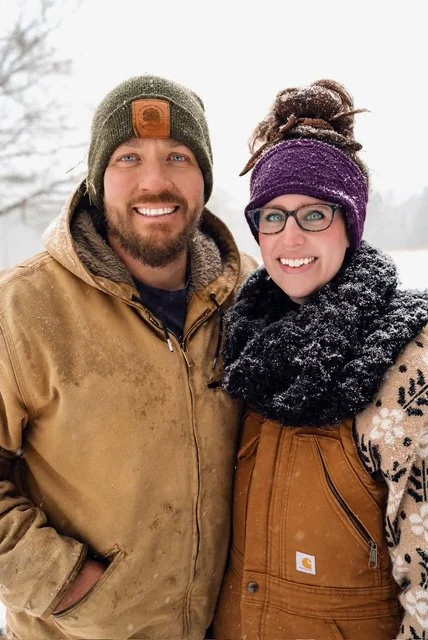
Daniel & Mandie